

In the UAE, your living room faces up to 4,000 hours of sunshine every year. This intense ambient light makes a standard white screen practically useless during the afternoon. You've likely invested in a high-end projector only to see the image turn grey and washed out the moment the sun hits your windows. It's a common frustration for villa owners who want a cinematic experience without living in a permanent cave. You expect premium equipment to perform, but light physics often wins the battle.
Choosing the right projector screen for bright room UAE environments is the single most important factor for image quality. In these high-light spaces, the screen is actually more responsible for the final picture than the projector itself. This guide helps you master the art of daylight cinema by selecting the exact light-rejecting technology your home requires. We will demystify the confusion between ALR, CLR, and Fresnel optics. You'll learn which professional hardware, from QMJM floor-rising models to Carvy motorized screens, delivers high-contrast viewing. We'll also confirm the best setups to ensure your equipment performs exactly as expected in your specific room layout.
Key Takeaways
- Learn why standard white screens fail in the intense UAE sun and how light-rejecting technology preserves deep black levels.
- Understand the technical differences between ALR and CLR to ensure your projector screen for bright room UAE matches your specific hardware.
- Explore sleek integration options like QMJM floor-rising or Carvy motorized screens that maintain the aesthetic of a modern villa.
- Discover the essential steps for measuring ambient light sources and calculating the ideal screen size for your viewing distance.
- See why professional installation is critical for achieving perfect 4K clarity and the correct viewing angles required for optical materials.
The Daylight Dilemma: Why Standard Screens Fail in UAE Living Spaces
UAE living rooms are architectural masterpieces. They feature massive windows, open-plan layouts, and an abundance of natural light. For a projector, however, these features are a significant challenge. Standard matte white screens are designed for controlled, dark environments. In a typical UAE villa, these surfaces act as light magnets. They don't just reflect your movie; they reflect every ray of sun and every recessed LED spotlight in the room. This results in a picture that looks faded, milky, and uninspiring.
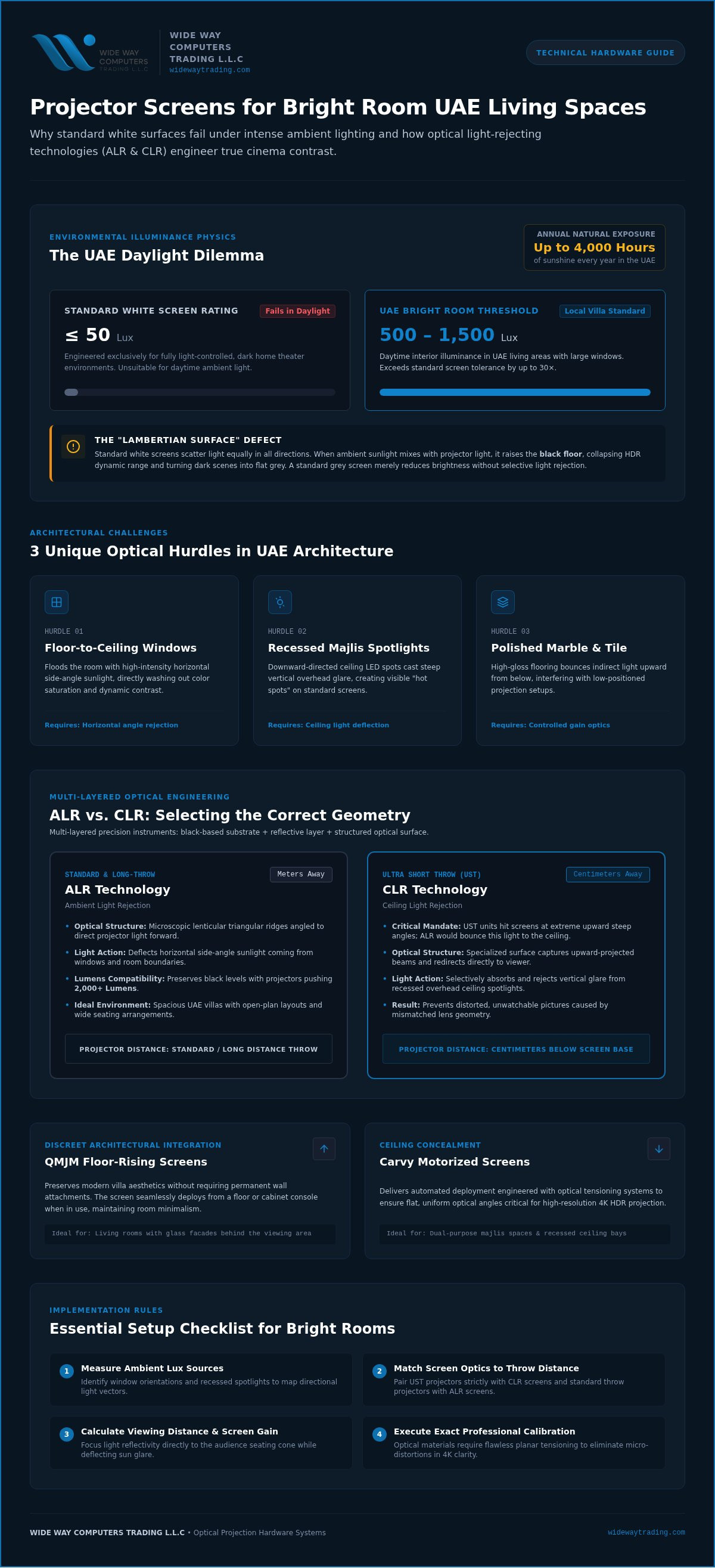
There's a psychological gap between a functional image and a premium cinema experience. A functional image is one where you can technically see what is happening on screen. It's "good enough" for news, but it fails for movies or sports. A premium experience requires deep black levels and vibrant color saturation. Without a specialized projector screen for bright room UAE conditions, you lose the high-dynamic-range (HDR) depth that makes modern 4K projectors worth the investment. We define the "Bright Room" threshold in local architecture as any space where daytime interior illuminance reaches 500 to 1,500 lux. Traditional screens are only rated for 50 lux or less.
The Physics of Reflection and Contrast
Standard screens use "lambertian" surfaces. They scatter light in every direction. When intense UAE sunlight hits a white screen, it mixes with the projector's light. This raises the "black floor." Your dark scenes turn into a flat grey. A common misconception is that a simple grey screen solves this. It doesn't. A basic grey surface reduces overall brightness but doesn't selectively reject light. Understanding projection screen gain and materials is the only way to combat this physics problem. Gain is the measurement of a screen's light reflectivity compared to a standard white board; in 2026, high-performance screens use controlled gain to focus light toward the viewer while ignoring the sun.
Common Lighting Challenges in Local Homes
Local homes present unique optical hurdles that require professional hardware. High-gloss marble or polished tile floors reflect light back onto the screen from below. Floor-to-ceiling windows flood the space with side-angle light that washes out the image horizontally. Additionally, the recessed LED spotlights common in UAE majlis areas create "hot spots" on standard surfaces. Closing the curtains isn't always the desired solution. You want to host guests and enjoy your home's views without sitting in the dark. A dedicated projector screen for bright room UAE applications allows for this social flexibility, maintaining high contrast even in a fully lit environment.
ALR vs. CLR: Selecting Technology That Beats Ambient Light
In the UAE retail market, terminology often gets blurred. You'll see products labeled as ALR or CLR, sometimes interchangeably. Choosing a projector screen for bright room UAE setups requires understanding that these are distinct optical solutions. They use different physical layers to tackle light based on where your projector is placed. Using the wrong technology won't just give you a poor image; it might leave you with a completely dark screen.
Optical screens aren't just flat surfaces. They're multi-layered precision instruments. They typically feature a black-based substrate, a reflective layer, and a structured optical surface. These layers work together to ensure that only the light from your projector reaches your eyes, while unwanted light from windows or lamps is absorbed or deflected elsewhere. Understanding the nuances of ALR vs. CLR screen technologies is vital because using the wrong geometry results in a distorted, unwatchable picture.
How ALR Technology Works
Ambient Light Rejection (ALR) is designed for standard or long-throw projectors mounted several meters away. These screens use microscopic lenticular structures. Think of them as tiny triangular ridges. These ridges are angled to reflect the light coming from the projector toward your eyes while deflecting light coming from the sides. In spacious UAE villas with open floor plans, ALR screens provide uniform image quality across wide seating areas. High-grade ALR materials effectively preserve deep black levels even when your projector is pushing 2000+ lumens in a lit room.
Why CLR is Essential for Ultra Short Throw (UST)
Ultra Short Throw projectors sit just centimeters below the screen. Because the light hits the surface at an extreme upward angle, a standard ALR screen would reflect that light toward the ceiling. You need Ceiling Light Rejection (CLR). CLR screens use a sawtooth structure where the top of each ridge is black to absorb light from overhead LEDs. The bottom is reflective to catch the steep beam from the UST unit. If you're unsure which optical layer matches your specific hardware, consulting with a specialist for projector screen installation ensures you don't waste your investment.
For the harshest daytime conditions, Fresnel screens offer a different approach. They use concentric circular lenses to focus light strictly forward. This provides a "gain" or brightness boost of up to 1.4, which is ideal for viewing in rooms with windows on both sides. However, Fresnel screens have narrower viewing angles. For a traditional Arabian majlis where guests sit at wide angles, a lenticular CLR screen remains the superior choice for consistent quality across all seats.
Matching Your Screen to Your Projector and Room
Performance is a partnership. A high-lumen projector is only half the equation. You must align the screen technology with your projector's throw distance and the room's layout. In a projector screen for bright room UAE setup, the hardware needs to be as resilient as the architecture. Choosing the wrong surface can degrade even the most expensive 4K image into a flat, uninspired display. You don't want to invest in premium optics only to have the light physics work against you.
Projector Synergy: Sony, BenQ, and LG Compatibility
Sony laser projectors are renowned for their high brightness and color accuracy. Pairing a 2026 Sony laser model with a Fresnel ALR screen maximizes peak luminance. This combination is ideal for daylight viewing where the sun is the primary competitor. BenQ models, often used for gaming and versatile media rooms, benefit from standard ALR surfaces that balance contrast with wide viewing angles. If you use an LG Ultra Short Throw (UST) projector, a dedicated CLR surface is non-negotiable. Without it, the 4K sharpness and HDR depth are lost to ceiling reflections.
Aesthetic Integration: Motorized and Floor-Rising Solutions
Modern villas often prioritize a clean, minimalist aesthetic. The QMJM Cabinet ALR Floor-Rising Screen 120″ is a premier choice for these spaces. It remains hidden within a sleek console and rises only when needed. This is a perfect space-saving solution for multi-purpose living areas. For those who prefer ceiling-mounted setups, Carvy Motorized Cinema Screens offer a "now you see it, now you don't" experience. These motorized options are ideal for versatile rooms where a permanent black box on the wall isn't desired. Fixed frame screens remain the standard for dedicated media rooms where the screen is the focal point.
Size selection is equally critical. For most UAE villas, 100-inch to 120-inch screens represent the sweet spot. This range provides a massive cinematic feel without overwhelming the wall or requiring extreme projector brightness. Following a CEDIA smart home cinema and media room guide helps ensure your screen size and viewing distance are mathematically balanced for long-term comfort. Finally, consider material durability. Local climate conditions, specifically high humidity and constant air conditioning, require tensioned screens that won't warp or curl over time. High-quality projector screen for bright room UAE materials are engineered to stay perfectly flat for years.
5 Steps to Setting Up a High-Performance Cinema in a Bright Room
Setting up a projector screen for bright room UAE environments is a technical challenge that requires a structured approach. It is not enough to simply buy high-end gear; you must harmonize the hardware with the room's unique optical signature. Precision is everything because light physics does not compromise. Follow these five steps to ensure your daylight cinema performs at its peak.
Step 1: Light Mapping Your Space
Start by identifying your primary light sources and trouble spots. UAE villas often feature panoramic windows and high-gloss tile flooring that produce complex reflection patterns. Use a light meter app to measure ambient illumination; if levels exceed 500 lux during peak hours, you need an ALR or CLR surface engineered specifically to deflect intrusive rays.
Step 2: Selecting Screen Size and Gain
Calculate your ideal screen size based on viewing distance, with 100-inch to 120-inch displays serving as the standard for most local living rooms. Choose an optical surface with the right gain rating. An ALR screen with a 0.6 to 0.8 gain deepens the black floor and preserves contrast without sacrificing color richness.
Step 3: Matching Projector Lumen Output
Pair your ambient light rejecting surface with a projector capable of cutting through daylight. Premium high-lumen laser projectors from brands like Sony or BenQ supply the raw output needed to overcome bright desert sunlight while preserving fine 4K detail across the entire display area.
Step 4: Precision Placement for Optical Screens
Optical screens rely on a strict viewing cone, meaning incorrect placement causes severe drops in contrast and brightness. Even a minor 5-degree tilt can reflect projector light toward the ceiling rather than your seating area. Ensure the projector lens is aligned precisely with the screen's optical axis.
Step 5: HDR Calibration and Final Tuning
Factory picture profiles are tuned for pitch-black cinema rooms, not luminous living spaces. Adjust your projector's HDR tone mapping to boost shadow detail and maintain image punch in daylight. To achieve optimal optical alignment and picture calibration, turn to WIDE WAY COMPUTERS TRADING L.L.C for specialized projector screen installation.
Professional Integration: Why Expert Installation is Non-Negotiable
Mounting a high-performance projector screen for bright room UAE environments isn't a simple weekend DIY project. The technical requirements for optical screens are far more demanding than standard white surfaces. Precision is the difference between a washed-out image and a true daylight cinema. If the alignment is off by even a few millimeters, the light-rejecting properties of the material are neutralized. You've invested in premium hardware. Professional integration ensures that hardware performs to its maximum potential.
Motorized and floor-rising systems like the QMJM Cabinet ALR Floor-Rising Screen 120″ require precise electrical integration and structural alignment. If the housing isn't perfectly level, the screen material will develop waves or "V" shapes over time. These waves distort the microscopic lenticular or Fresnel surfaces, leading to uneven brightness. For 4K and 8K clarity, perfect tensioning is essential. Tab-tensioned systems use specialized cords to pull the material into a true flat plane. Our installers use laser levels and physical alignment tools to guarantee this precision, avoiding the need for digital keystone correction that degrades image sharpness.
The Wide Way Installation Advantage
We provide professional mounting for Carvy and QMJM systems across the UAE. Our team understands the local architectural challenges, from reinforced concrete villa walls to gypsum partitions in high-rise towers. We handle the heavy lifting and the technical calibration. We go beyond the screen. We integrate your audiovisual system with your wider home infrastructure. This includes discreet cable management and connecting your setup to your existing IT and audio networks. Expert calibration for Sony, BenQ, and LG models ensures the projector's output matches the screen's optical gain perfectly. Premium hardware needs care. We offer ongoing support to maintain your screen's tension and your projector's alignment over the years.
Completing Your Setup
A total smart home experience requires synergy. We see a direct connection between your security systems and your cinema room. Integrating EZVIZ or eufyCam cameras with your media room allows you to monitor your property without leaving your seat. Professional site surveys are the foundation of this process. They prevent costly hardware mismatches by verifying light angles and wall substrates before you commit to a purchase. This methodical approach ensures your projector screen for bright room UAE setup works in perfect harmony with your lifestyle. Book a consultation with Wide Way for your professional home cinema setup to ensure your technology is integrated with precision and care.
Transform Your Living Room Into a Daylight Cinema
The intense sunlight of the UAE doesn't have to compromise your home entertainment. By selecting a specialized projector screen for bright room UAE conditions, you move beyond washed-out images and into true 4K clarity. You now understand that the screen material is just as critical as the projector itself. Whether you choose a QMJM floor-rising unit or a Carvy motorized system, the key is matching the optical layer to your specific environment and hardware.
Expert integration is the final step to achieving a premium experience. As authorized dealers for Sony, BenQ, and LG, we specialize in the precision required for ALR and CLR technology. Our professional installation team provides national UAE coverage to ensure your system is calibrated for the perfect viewing angle. Don't settle for "good enough" when professional-grade daylight cinema is within reach. Design your dream bright-room cinema with Wide Way's expert team and enjoy high-contrast viewing any time of day. Your ultimate home theater experience starts with the right partner.
Frequently Asked Questions
Is an ALR screen worth it for a bright living room in the UAE?
Yes, an ALR screen is essential for any bright living space. Standard matte white screens reflect light in all directions, causing the image to look washed out when the sun is up. An ALR surface selectively reflects the projector's light while absorbing ambient light from the sides. This technology is the only way to maintain deep black levels and vibrant colors without closing all your curtains during the afternoon sun.
Can I use a regular white screen with an Ultra Short Throw (UST) projector?
You shouldn't use a regular white screen with a UST projector because it ruins the image quality. UST projectors throw light upward at an extreme angle. A standard white surface reflects that light directly toward your ceiling rather than your eyes. For these setups, a CLR screen is required. It uses a sawtooth structure to catch the projector's light while blocking overhead LED spotlights common in local villas.
What is the best screen size for a standard UAE villa living room?
The 100-inch to 120-inch range is the ideal sweet spot for most villa living rooms. This size provides a massive, cinematic feel that a standard television cannot match. It also ensures the image remains bright and sharp when paired with high-performance 4K projectors. Going larger than 120 inches in a bright room often requires a significantly more powerful projector to maintain the necessary peak luminance for daytime viewing.
How do I clean a specialized ALR or CLR projector screen?
You must clean a specialized projector screen for bright room UAE surfaces with extreme care. These screens feature microscopic optical ridges that are easily damaged by liquids or abrasive cloths. Use a very soft-bristled brush or a dry microfiber cloth to gently remove dust. Never use window cleaners, alcohol, or soaps; these chemicals can strip the light-rejecting coatings and permanently destroy the screen's ability to handle ambient light.
Do I need a professional to install a motorized floor-rising screen?
Professional installation is highly recommended for motorized floor-rising screens to ensure long-term performance. These systems, like the QMJM models, rely on precise horizontal leveling and tensioning. If the unit is even slightly tilted, the screen material may develop waves or memory lines that distort the 4K image. Experts also handle the electrical integration and ensure the projector's optical axis is perfectly aligned with the screen's specific sweet spot.
What is the difference between an ALR screen and a Fresnel screen?
The primary difference lies in how they redirect light. Standard ALR screens use horizontal lenticular ridges to reject light from the sides, making them ideal for wide seating areas. Fresnel screens use concentric circular lenses to focus light strictly forward toward the center seats. A Fresnel screen offers higher gain and better brightness in very lit rooms but has narrower viewing angles compared to a traditional lenticular ALR or CLR surface.
Can I see the projector image clearly with the lights on using an ALR screen?
You can see the image clearly with the lights on if you use a high-lumen projector paired with an ALR screen. For a projector screen for bright room UAE setup to work with overhead LEDs, the projector should output at least 2,500 to 3,500 ANSI lumens. The screen technology will absorb the ceiling light, while the projector's high output ensures the colors remain punchy and the whites stay bright even in a fully lit room.
Does Wide Way provide installation services for all brands of projectors?
Wide Way provides professional installation services for a wide range of projector brands across the UAE. While we are authorized dealers for Sony, BenQ, and LG, our team is trained to calibrate and mount various high-end projection systems. We ensure that your chosen hardware is perfectly paired with the correct ALR or CLR screen technology. Our services include structural mounting, cable management, and smart home integration to create a seamless cinema experience.


