

Why let a massive, lifeless black rectangle dictate the entire aesthetic of your living room? For many, the dream of a 120-inch home theater often dies when faced with the reality of permanent wall mounts or the eyesore factor of a giant TV. You want the immersive experience, but you don't want your home to look like a sports bar when the power is off. The qmjm floor rising screen offers a sophisticated way out. It provides a true disappearing cinema that rises from a sleek, floor-based chassis only when you need it.
We understand that a high-end interior shouldn't be compromised by bulky hardware or washed-out images. It's a common frustration to see a premium projector struggle against ambient light or to deal with rental restrictions that forbid wall drilling. This guide gives you the definitive roadmap to upgrading your home cinema for 2026. You'll learn how to select the right fabric to reject 95% of ceiling light and achieve 4K or 8K image quality in broad daylight. From technical specs to professional installation without damaging your walls, we've curated everything you need to transform any space into a professional theater.
Key Takeaways
- Transform any room into a high-end cinema using a motorized mechanism that completely retracts when not in use.
- Choose the right fabric technology to reject up to 95% of ambient light for a vivid 4K experience in daylight.
- Navigate the full size spectrum from 72 to 150 inches to find the ideal match for your specific room dimensions.
- Explore the minimalist benefits of a qmjm floor rising screen integrated directly into a bespoke media cabinet.
- Ensure long-term reliability with professional installation and national support from authorized specialists.
What is a QMJM Floor Rising Screen and Why Do You Need One?
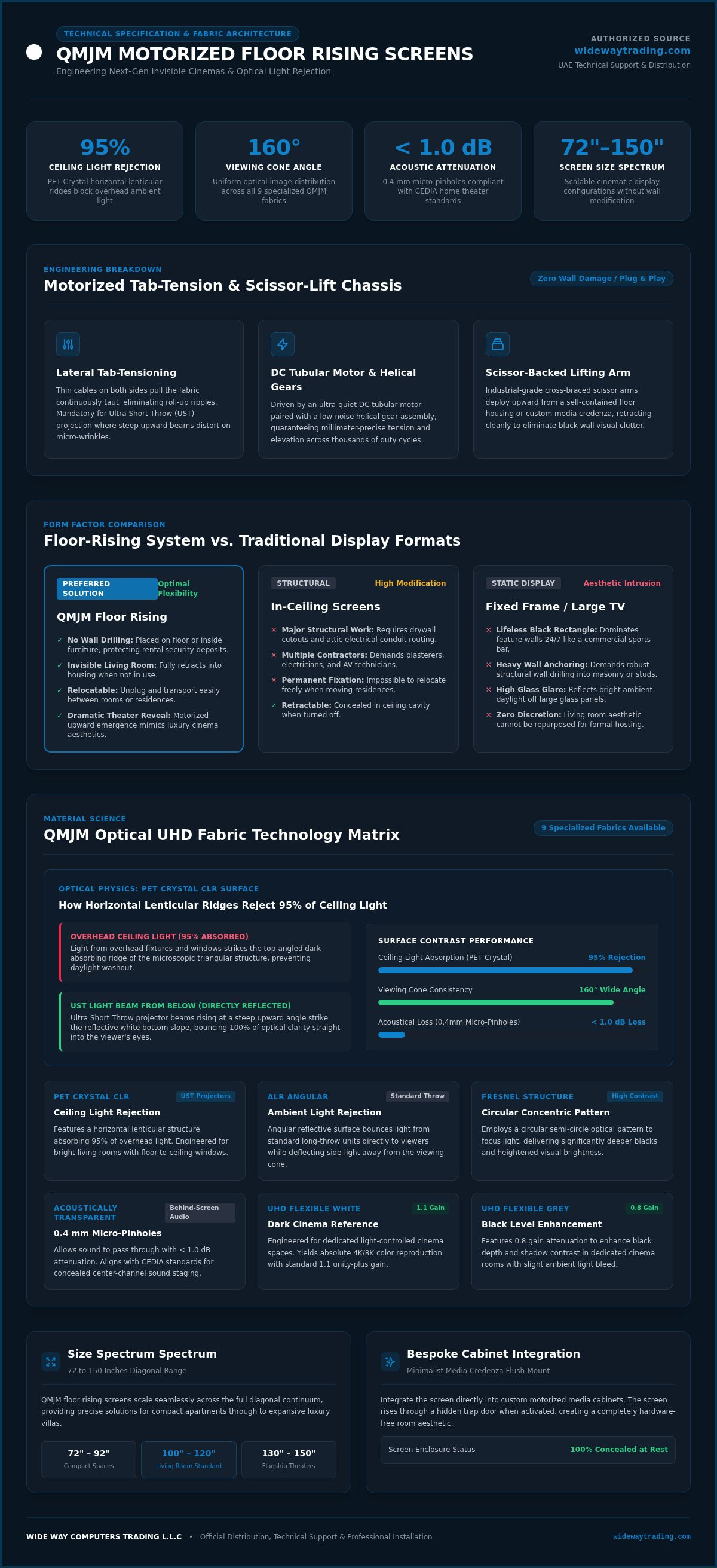
A qmjm floor rising screen is a motorized projection surface that emerges from a compact, floor-based housing. Unlike traditional fixed-frame screens that dominate a wall 24/7, these units remain hidden until you're ready to watch. The mechanism uses a scissor-backed lifting system powered by ultra-quiet DC tubular motors. This design creates an "invisible" home cinema. Your living room remains a multi-purpose space, free from the visual clutter of a massive black rectangle.
Modern architecture often favors large windows and minimalist feature walls. Drilling into these surfaces isn't always an option. These motorized floor-rising screens solve this by being entirely self-contained. You place the unit on the floor or inside a specialized cabinet, plug it in, and the setup is complete. This portability is a game-changer for luxury apartment tenants who want a flagship theater experience without risking their security deposit. QMJM has become a preferred brand nationally because they balance industrial-grade reliability with furniture-grade aesthetics.
The Motorized Tab-Tension Advantage
Surface flatness is the most critical factor for image quality. The qmjm floor rising screen utilizes a sophisticated tab-tensioning system. Thin cables on either side pull the fabric taut, eliminating the ripples common in standard roll-up screens. This precision is mandatory for Ultra Short Throw (UST) projectors. Because UST units project light at a steep upward angle, even a minor wrinkle creates distracting shadows and distorted lines. QMJM’s helical low-noise gear system ensures this tension remains consistent over thousands of cycles, providing a durable, quiet, and perfectly flat viewing surface.
Floor Rising vs. In-Ceiling Screens
In-ceiling screens require significant structural modifications. You often need to cut into drywall, run electrical conduits through the attic, and hire multiple contractors. It's a permanent commitment. In contrast, a floor-rising model offers immediate gratification. It provides a more dramatic visual impact as the screen rises from the ground, mimicking the reveal of a high-end commercial theater. For those prioritizing a minimalist interior, the ability to relocate the screen to a different room or take it with you when you move makes it the superior investment. Installation effort is minimal, and the structural integrity of your home remains untouched.
Technical Deep-Dive: QMJM ALR and CLR Fabric Technology
The fabric is the engine of your qmjm floor rising screen. It determines whether your image pops with vibrant color or washes out under the midday sun. QMJM provides a selection of nine specialized UHD fabrics. Each is engineered for a specific lighting environment, moving far beyond the capabilities of a standard white wall or basic vinyl surface.
Ambient Light Rejection (ALR) is the foundation for standard long-throw projectors. These screens use an angular reflective surface. They bounce light from the projector directly toward the audience while reflecting side-light away from the viewing cone. This significantly improves contrast in rooms where you cannot achieve total darkness. It is a reliable solution for traditional home theater layouts.
Ceiling Light Rejection (CLR) technology is the gold standard for Ultra Short Throw (UST) projectors. These screens, often called PET Crystal, feature a horizontal lenticular structure. Microscopic ridges catch the light rising steeply from the projector below while absorbing up to 95% of overhead illumination. This allows you to enjoy a 120-inch display in a bright living room without losing black levels or color saturation.
For those seeking the pinnacle of contrast, the Fresnel structure offers a different approach. It uses a circular semi-circle pattern to focus light. This results in even higher brightness and deeper blacks compared to standard ALR surfaces. If your setup includes hidden speakers, the Acoustically Transparent (AT) fabric is the right choice. It features 0.4 mm micro-pinholes that allow sound to pass through with less than 1.0 dB of attenuation. This ensures your audio remains crisp while adhering to CEDIA home theater standards for professional sound staging.
Choosing the Right Fabric for Your Lighting
Your choice depends on your room's windows and lighting control. Dedicated, dark cinema rooms benefit most from UHD Flexible White (1.1 gain) or Grey (0.8 gain) materials. These provide the most accurate color reproduction. In contrast, bright living rooms with floor-to-ceiling windows require the PET Crystal CLR. All QMJM fabrics maintain a 160 degree viewing angle. This ensures every guest sees a uniform image without color shifting or dimming at the edges.
4K and 8K UHD Compatibility
Texture is the enemy of high resolution. Standard screens often have a visible grain that creates a "screen door" effect on 4K images. QMJM UHD materials use a smooth, multi-layer composite ranging from 0.32 mm to 0.49 mm in thickness. This surface is fine enough to resolve every pixel of an 8K laser projector. It eliminates hot-spotting and ensures a clean, film-like texture. You can explore the full range of ALR and CLR projector screen options to find the perfect match for your hardware. This level of precision future-proofs your investment as projection technology continues to evolve.
QMJM Size Guide: From 72 to 150 Inches
The qmjm floor rising screen comes in a diverse range of sizes to fit any architectural context. Available options include 72, 84, 92, 100, 110, 120, 135, and 150 inches. Selecting the correct size is not just about available floor space. It involves balancing visual comfort with the technical capabilities of your projector. Most modern home cinema enthusiasts opt for the 16:9 aspect ratio. This format aligns perfectly with 4K UHD content, streaming services, and gaming consoles. While widescreen 2.35:1 models exist for dedicated "Scope" theaters, they often require specific lens memory functions on your projector to function correctly.
Viewing distance remains the primary metric for size selection. For a 100-inch screen, a seating distance of roughly 3 meters is ideal. Stepping up to 120 inches usually requires 3.6 to 4.5 meters for an immersive yet comfortable field of view. Larger 135 and 150-inch models demand significant room. The housing for a 150-inch unit can exceed 3.5 meters in length and carries substantial weight. These massive surfaces rely heavily on advanced ambient light rejecting and CLR screen technology to maintain image punch. Without high-gain materials, the light from the projector spreads too thin over the increased surface area, leading to a dim image.
The Sweet Spot: Why the 120-Inch Model Dominates
The 120-inch qmjm floor rising screen is the industry standard for premium home theaters. It provides a massive jump in scale from conventional 85-inch TVs while remaining manageable for most living rooms. This size pairs perfectly with high-end UST projectors from brands like Sony and BenQ. The housing fits comfortably against a feature wall or under most standard media consoles. It offers the best balance of cinematic immersion and practical integration into a multi-purpose living space.
Going Big: Planning for a 150-Inch Cinema
Moving to a 150-inch screen requires careful structural planning. These units are heavy and require a perfectly level floor. Any slight tilt can cause the scissor-back mechanism to bind over time. Power requirements are standard, but the physical footprint is significant. You also need a high-lumen projector. A 150-inch screen has over 50% more surface area than a 120-inch model. Your projector must output significant brightness to maintain 2026 standards for HDR performance and color vibrance. Floor stability and projector throw distance must be verified before committing to this flagship size.
The QMJM Cabinet Integration: The Ultimate Minimalist Setup
The "Zero Trace" philosophy is the driving force behind the QMJM Cabinet ALR Floor-Rising Screen 120″. It transforms a high-tech cinema into a piece of fine furniture. When the system is off, you see only a sleek, modern credenza. There are no visible wires. There is no black screen on the wall. There is no projector sitting on a coffee table. This all-in-one solution is the preferred choice for primary living areas where design is just as important as performance. It allows the technology to disappear completely when not in use.
Proper airflow is vital for high-performance laser projectors. The QMJM cabinet includes dedicated ventilation paths to prevent overheating during long film marathons. Cable management is equally streamlined. All power and HDMI connections remain hidden inside the chassis. This avoids the "cable nest" often found behind traditional TV stands. By integrating the qmjm floor rising screen directly into the cabinet, you eliminate the need for any visible hardware or floor-based housings.
Design and Aesthetics of the ALR Cabinet
The cabinet range uses high-quality finishes and bespoke wooden materials to complement modern interiors. It replaces bulky TV stands that often look out of place in a minimalist home. By consolidating the hardware into a single unit, you regain your feature wall for art or decor. The clean lines and hidden compartments ensure that the room's aesthetic remains undisturbed. It's a sophisticated architectural solution for those who refuse to compromise on style.
Integration with Ultra Short Throw Projectors
Compatibility is a core feature. The cabinet is specifically designed to house premium UST models from Sony, LG, and BenQ. A specialized compartment ensures the projector is always perfectly aligned with the screen surface. This eliminates the need for constant keystone adjustments or manual repositioning. The system utilizes a smart USB trigger linkage. When you turn on the projector, the screen emerges automatically. It retracts just as smoothly when you finish watching. You can view the full specifications for the QMJM Cabinet ALR Floor-Rising Screen 120″ to see how this integrated system fits your living space.
Professional Installation and Support in the UAE
Installing a qmjm floor rising screen requires more than just a nearby power outlet. These large motorized units are precision instruments. They are heavy and sensitive to the surface they sit on. Even a minor floor tilt can stress the scissor-back mechanism or cause uneven fabric tension over time. Wide Way provides the necessary expertise in both audiovisual and security system integration to ensure your investment is protected. They understand how these screens interact with high-end projectors and complex home automation setups.
Reliability is a core concern for any motorized hardware. Every screen purchased through an authorized reseller like Wide Way comes with a robust official warranty. This includes a 1-year replacement warranty and a 3-year general manufacturer warranty. The dedicated tubular motors are covered for up to 5 years. Having local, national support means you aren't left waiting for international shipping if a component needs attention. After-sales maintenance and technical support ensure the helical gear system remains quiet and efficient for years of daily use.
What to Expect During a Professional Setup
A professional installation begins with a thorough site assessment. Technicians check floor leveling and ensure power access is discreet and safe. Projector calibration is the next critical step. Aligning a 4K or 8K UST projector with a qmjm floor rising screen requires millimeter precision to avoid geometric distortion or focus issues. Finally, the team provides comprehensive user training. You'll learn how to operate the RF remote, set custom height limits, and manage the automated USB trigger linkage for a truly hands-off experience.
The Wide Way Advantage: Beyond the Box
Wide Way acts as a specialist curator rather than just a retailer. They offer a one-stop-shop experience that includes the screen and a portfolio of premium projectors from Sony, BenQ, and LG. This ensures total hardware compatibility from day one. With national delivery and expert on-site setup services, the transition from a traditional living room to a high-end cinema is seamless and stress-free. Explore the full QMJM range and book your installation at Wide Way.
Elevate Your Home Cinema Experience for 2026
A flagship home theater is no longer restricted to dark basements or permanent wall fixtures. By choosing a qmjm floor rising screen, you gain the flexibility to transform any room into a professional cinema without compromising your interior design. Whether you opt for a standalone 150-inch model or the seamless 120-inch cabinet integration, the result is a high-performance, disappearing display that excels even in bright daylight. You don't have to choose between a massive screen and a minimalist living space anymore.
Reliability is critical for motorized hardware. As an authorised QMJM reseller, Wide Way provides the technical expertise and support needed for a flawless setup. Every installation includes professional national delivery and the security of an official motor warranty for long-term peace of mind. It's time to stop settling for small TVs and start enjoying the immersive scale of a true cinematic experience in the comfort of your own home. Your perfect theater setup is just one step away.
Upgrade your home cinema with an official QMJM Floor Rising Screen at Wide Way
Frequently Asked Questions
Can I use a QMJM floor rising screen with a standard long-throw projector?
You can use a long-throw projector, but you must select the appropriate Ambient Light Rejecting (ALR) fabric. Standard long-throw projectors require angular reflective surfaces to bounce light toward the audience. Avoid using Ceiling Light Rejecting (CLR) or PET Crystal fabrics with these projectors. Those microstructures are strictly designed for Ultra Short Throw (UST) angles. Using the wrong combination will result in a dark, distorted image because the screen will treat the projector light as ambient interference.
How long does it take for a QMJM motorized screen to fully rise?
The qmjm floor rising screen typically takes between 20 and 30 seconds to fully extend or retract. The ultra-quiet DC tubular motors are engineered for smooth, steady movement rather than raw speed. This controlled pace protects the tab-tensioning system and ensures the fabric remains perfectly flat over years of use. The helical low-noise gear mechanism ensures the operation is discreet enough for any luxury living room environment or dedicated home cinema.
Is the QMJM ALR screen effective in a room with floor-to-ceiling windows?
These screens are highly effective in bright spaces when paired with the correct fabric. The PET Crystal CLR and ALR Fresnel materials are specifically engineered to reject up to 95% of overhead and side ambient light. While total light control always provides the best results, these specialized surfaces prevent the image from washing out. They maintain deep black levels and vibrant color saturation even in rooms with significant natural light or large window surfaces.
What happens if the motor on my floor rising screen fails?
You are protected by an extensive official warranty when purchasing through an authorized reseller. QMJM screens come with a 1-year replacement warranty and a 3-year general manufacturer warranty. The dedicated tubular motors are specifically covered for up to 5 years. Local technical support handles maintenance and component replacement, ensuring your system returns to full operation quickly. This national support network is a key benefit of choosing a professional provider for your home theater hardware.
Do I need a special cabinet for the QMJM floor rising screen?
A special cabinet is not mandatory for a qmjm floor rising screen. These units are entirely self-contained and can sit directly on any level floor surface. However, many homeowners choose the specialized 120-inch ALR cabinet model for a more minimalist aesthetic. This integrated furniture piece hides both the screen housing and the projector. It creates a "Zero Trace" look where the technology only appears when you're ready to watch, keeping your living area clean and wire-free.
Are QMJM screens compatible with 8K laser projectors?
Every QMJM UHD fabric is fully compatible with 8K laser projection technology. The surface texture is exceptionally fine, with material thicknesses ranging from 0.32 mm to 0.49 mm. This smooth composite prevents pixel distortion and the "screen door" effect common on lower-quality surfaces. By eliminating hot-spotting and maintaining uniform luminance, these screens are capable of resolving the high pixel density required for next-generation 8K displays, making them a future-proof investment for your home.
How do I clean a QMJM ALR or CLR projector screen safely?
Cleaning requires a gentle, dry approach to protect the delicate optical microstructures. Use a soft microfiber cloth or a soft-bristled brush to remove surface dust. Never use water, liquid cleaners, or abrasive chemicals, as these can permanently damage the sawtooth ridges that reject ambient light. Always wipe horizontally, following the direction of the ridges. If you encounter a stubborn mark, consult a professional technician to avoid compromising the screen's light-rejecting properties or gain.
Does the screen require a dedicated power outlet?
The screen operates on a standard power outlet and does not require a dedicated electrical circuit. The DC tubular motor has a relatively low power draw during its short operation cycles. For the cleanest installation, it's best to place an outlet directly behind the screen housing or inside the integrated media cabinet. This allows you to hide the power cable completely. Most setups also utilize a 12V USB trigger to synchronize the screen's power with the projector.


