

The massive 100-inch LED panel might be the most expensive way to get a mediocre home cinema experience in 2026. It's tempting to think a single box is simpler. You see a price tag, you buy it, and you're done. But for most living rooms, that giant glass slab brings hidden headaches. Between the sheer weight requiring reinforced walls and the glare from every window, the simple choice often becomes a logistical nightmare. You aren't just buying a screen; you're managing a major construction project.
We understand the hesitation. Choosing between a traditional panel and a Laser TV setup is a significant financial decision. This 100 inch tv vs ultra short throw projector cost comparison cuts through the marketing noise to reveal the real total cost of ownership. You'll discover the real total cost of ownership between giant LED panels and Laser TV setups to make the smartest investment for your home cinema. We'll break down the dollar-for-dollar differences, explain when to prioritize a Sony or LG projector over a panel, and show why professional installation is the only way to protect your investment. By the end, you'll know exactly which technology fits your lifestyle and your budget.
Key Takeaways
- Identify the hidden expenses of giant panels by performing a detailed 100 inch tv vs ultra short throw projector cost comparison that includes delivery logistics and wall reinforcement.
- Learn why a Laser TV system using Sony or BenQ hardware combined with an ALR screen offers better long-term flexibility for modern living spaces.
- Understand the structural challenges of mounting 100kg glass panels versus the precision required for professional UST projector and screen alignment.
- Compare the 30,000-hour lifespan of modern laser engines against traditional LED backlight degradation to see which technology offers the best return on investment.
- Determine if you are a "TV Winner" or "Projector Winner" based on your specific room lighting conditions and home cinema goals for 2026.
The 100-Inch Battle: Giant Panel vs. Laser Projection
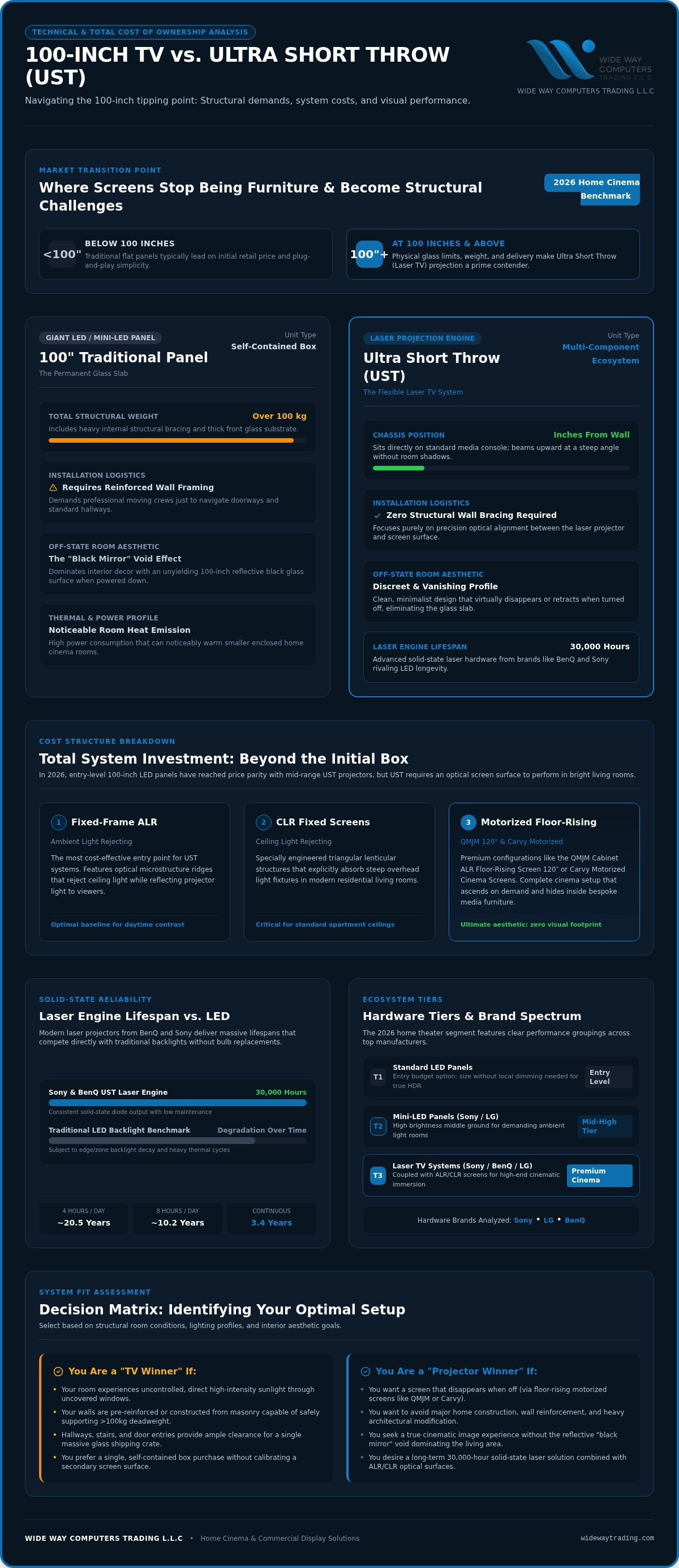
The 100-inch threshold marks a significant turning point in home cinema. It is the exact moment where a screen stops being a piece of furniture and starts becoming a structural challenge. In 2026, the market is split between two distinct technologies: traditional Mini-LED panels and Ultra Short Throw (UST) systems. While both offer massive visuals, the 100 inch tv vs ultra short throw projector cost comparison reveals that these are fundamentally different investments. One is a heavy piece of hardware; the other is a sophisticated light system.
The rise of the "Laser TV" category has blurred these lines. Manufacturers now bundle high-end projectors with specialized screens to mimic the TV experience. This shift has made 100 inches the tipping point for value. Below this size, traditional TVs usually win on price. At 100 inches and above, the physical limitations of glass and metal make projection a serious contender. You are no longer just choosing a brand. You're choosing between a permanent glass wall and a flexible, cinematic light engine.
What is an Ultra Short Throw Projector?
A UST projector is a specialized device designed to sit just inches away from your wall. Unlike traditional projectors that require ceiling mounts and long cable runs, these units sit on your media console. They use an advanced laser projector technology to beam light at a steep upward angle. This creates a massive image without the shadows or installation complexity of older systems.
It's vital to remember that a UST is a system, not a solo device. To achieve TV-like clarity in a bright living room, you must pair the projector with an Ambient Light Rejecting (ALR) screen. Brands like BenQ and Sony have optimized these engines to last up to 30,000 hours. This longevity brings them into direct competition with the lifespan of traditional LED backlights. It's a clean, minimalist solution that disappears when turned off.
The 100-Inch TV Landscape in 2026
Giant LED and Mini-LED panels have become more affordable, but they haven't become lighter. A 100-inch TV is a logistical beast. These units often weigh over 100kg once you include the internal bracing and glass. This weight demands reinforced walls and professional crews just to get the box through your front door. They also consume significantly more power than their smaller siblings, generating heat that you'll feel in a smaller room.
There is also the aesthetic cost to consider. Designers often call this the "Black Mirror" effect. When the TV is off, you're left with a 100-inch void of reflective black glass that dominates the room's decor. While the image quality in bright sunlight is nearly unbeatable, the sheer presence of the hardware is a permanent commitment. It's a high-performance tool that requires your room to be built around it.
Direct Cost Breakdown: Purchase Price vs. Total System Investment
Comparing these two technologies on purchase price alone is misleading. A 100-inch TV is a self-contained unit. You buy the box, and you have a screen. An Ultra Short Throw projector is a component in a larger ecosystem. When performing a 100 inch tv vs ultra short throw projector cost comparison, you must account for the mandatory screen and the specific hardware tier. In 2026, entry-level 100-inch LED panels have reached price parity with mid-range UST projectors, but the projector still requires a specialized surface to function in a standard living room.
Projector Screen Costs: ALR, CLR, and QMJM Floor-Rising
A common mistake is assuming a white wall is sufficient. It isn't. To compete with the brightness of a TV, a UST projector needs an Ambient Light Rejecting (ALR) or Ceiling Light Rejecting (CLR) screen. Fixed-frame ALR screens are the most cost-effective entry point. However, many premium setups now utilize a QMJM Cabinet ALR Floor-Rising Screen 120″ or Carvy Motorized Cinema Screens. These motorized options add a significant premium to the initial investment but allow the cinema to disappear when not in use. You can find detailed performance data in expert projector reviews and recommendations to see how different screens impact contrast ratios.
TV Pricing Tiers
The TV market at 100 inches is split into three clear tiers. Standard LED panels are the budget option. They offer size but lack the local dimming needed for true HDR. Mini-LED models from brands like Sony or LG provide a middle ground, offering high brightness that rivals projectors in sun-drenched rooms. OLED remains the luxury outlier; a 100-inch OLED panel is still a massive investment that dwarfs the cost of even a high-end BenQ or Sony laser projector setup. While TVs have high initial costs, their depreciation is steep. A giant panel loses value faster than a high-quality projector lens and laser engine.
Over a five-year period, the total cost of ownership balances out. Projectors use less power and have modular parts. A 100-inch TV is a single point of failure. If the panel cracks, the entire investment is gone. For a tailored breakdown of these expenses, you can request a professional home cinema consultation to see which system fits your specific room layout. High-end projectors tend to hold their value better among enthusiasts, whereas 100-inch TVs follow the rapid price decay of standard consumer electronics.
Hidden Installation and Infrastructure Costs
The 100 inch tv vs ultra short throw projector cost comparison often hinges on what happens after the delivery truck arrives. Buying the hardware is only the first phase. A 100-inch TV isn't just a purchase; it's a construction project. These panels often weigh around 100kg. That weight requires structural reinforcement for standard walls. You can't simply buy a bracket and hope for the best. If you don't reinforce the mounting point, you risk a catastrophic failure that destroys your investment and your wall.
Logistics present another hidden expense. Moving a box of this size through standard hallways or elevators is a specialized task. Many retailers charge a premium for "white glove" delivery because a two-man crew isn't enough. In contrast, an Ultra Short Throw (UST) projector and a QMJM Cabinet ALR Floor-Rising Screen 120″ arrive in much smaller, manageable packages. The infrastructure cost for a UST setup is focused on precision rather than brute force. While you don't need to reinforce the floor, you do need a perfectly level surface. Even a millimeter of tilt at the lens translates to a distorted image on the screen.
Professional AV Installation Services
Professional mounting is non-negotiable for 100-inch screens. Expert installers ensure the weight is distributed across studs and use heavy-duty steel mounts designed for oversized loads. This service also covers the integration of home automation. If you want your screen to descend from the ceiling or rise from a cabinet, you need specialized wiring. Motorized solutions like Carvy Motorized Cinema Screens require dedicated power runs and calibration to sync with your projector's trigger system. This level of precision prevents the "keystone" distortion that ruins the cinematic feel.
Room Modification Costs
Your room's environment directly affects the total system value. A 100-inch TV is bright enough to fight through glare, but it still benefits from blackout curtains to prevent reflections on that massive glass surface. UST projectors are more sensitive. Even with a high-quality ALR PROJECTOR SCREEN, you may need to invest in light-blocking window treatments to get the best contrast. Furniture is another factor. A standard media console won't support a 100kg TV safely. You'll need a heavy-duty stand or a custom-built UST credenza that places the projector at the exact distance required for a 100-inch throw. These furniture upgrades are essential parts of the total investment that many buyers overlook until the equipment is already in the room.
Longevity and Visual Performance: Getting Your Money’s Worth
Visual performance isn't just about the first day of use. It's about how the image holds up after three years of daily viewing. A comprehensive 100 inch tv vs ultra short throw projector cost comparison must account for how these systems age. In 2026, laser engines in Sony and BenQ projectors are rated for 20,000 to 30,000 hours. If you watch five hours of content every day, the light source will last over 11 years. While LED backlights in 100-inch TVs have similar ratings, they often suffer from "clouding" or individual zone failures long before the LEDs actually burn out.
The "Daylight Cost" is the most significant performance gap. TVs measure brightness in Nits, while projectors use Lumens. A 100-inch Mini-LED TV provides raw, direct light that can punch through even the brightest midday sun. However, this direct light causes more eye strain over long sessions. Projectors offer a different health value. They use reflected light, which mimics how we see the natural world. This significantly reduces blue light exposure. It's a more comfortable experience for movie marathons, even if it requires more effort to manage ambient light.
Energy consumption adds a predictable monthly cost to your bill. A massive 100-inch LED panel is a power-hungry beast, often drawing between 400 and 600 watts depending on brightness settings. Most UST projector units operate more efficiently, typically sitting between 200 and 300 watts. Over a five-year period, the projector can save you a noticeable amount in utility costs, partially offsetting the higher initial price of a premium ALR screen.
Maintenance and Repairs
Repairability is where the two technologies diverge sharply. A 100-inch TV is essentially a single sheet of fragile glass. If a child throws a toy or a moving crew mismanages the box, a cracked panel means the entire unit is e-waste. You cannot "fix" a broken 100-inch screen. Projectors are more resilient because the "screen" and the "engine" are separate. If the projector needs a new fan or a software board, it's a serviceable unit. You only need to keep the filters clean and the lens dust-free to maintain peak performance.
The Ambient Light Factor
Achieving "perfect" blacks in a sunlit room used to be the exclusive domain of high-end TVs. Modern ALR Fresnel screens have equalized the playing field. These screens use microscopic triangular structures to reflect projector light toward the viewer while absorbing light from the ceiling and windows. This technology allows a BenQ or LG projector to maintain high contrast even with the lights on. The trade-off is a narrower viewing angle compared to a TV. If you want the best visual performance for your specific room layout, consult with our AV specialists to find the right hardware match.
Expert Recommendation: Choosing the Right Setup for Your Home
The final decision in the 100 inch tv vs ultra short throw projector cost comparison depends on your room's environment and your primary content. In 2026, neither technology is a universal winner. Instead, the best value is found by matching the hardware to your specific lifestyle. A 100-inch TV is a powerhouse for certain users, while a UST system offers a level of sophistication and immersion that a glass panel simply cannot match.
The TV Winner profile is the dedicated gamer or the casual viewer in a sun-drenched living room. If you require 144Hz refresh rates for competitive gaming or you refuse to close your curtains during a midday football match, the raw brightness of a Mini-LED panel is worth the logistical headache. It provides a "set and forget" experience that thrives in high-glare environments.
The Projector Winner profile is the movie buff or the minimalist. If you want a 100-inch cinema that disappears when not in use, a UST projector is the only viable path. It offers superior eye comfort for long sessions and creates a true theater atmosphere. For these users, the system investment in a high-quality laser engine and an ALR screen provides much higher long-term satisfaction than a giant, reflective black mirror on the wall.
WIDE WAY COMPUTERS TRADING L.L.C Integrated Solutions
We specialize in curating hardware that works as a unified system. Our most popular 2026 configurations pair Sony or BenQ projectors with specialized surfaces like the QMJM Cabinet ALR Floor-Rising Screen 120″. This setup allows the entire cinema to remain hidden inside a sleek cabinet until you are ready to watch. For permanent wall installations, we recommend Carvy Motorized Cinema Screens to maintain a clean aesthetic. Bundling these components with our professional installation services ensures you avoid the costly infrastructure mistakes mentioned in previous sections. WIDE WAY COMPUTERS TRADING L.L.C handles the precision calibration required to make a laser engine truly compete with a high-end TV.
Next Steps for Your Home Cinema
Making the leap to a 100-inch display requires careful planning. Before you commit to a purchase, we recommend a few practical steps to protect your investment:
- Request a Site Survey: Our team can assess your wall strength and ambient light levels to determine if a heavy TV or a UST system is safer for your home.
- Visit the Showroom: Compare a BenQ or LG projector side-by-side with a 100-inch panel to see the difference between reflected and direct light.
- Check Your Logistics: Measure your doorways and elevators. If a 100-inch TV box won't fit, a projector and a rolling screen are your best alternatives.
The smartest investment is one that fits your room without requiring expensive structural changes. Whether you choose the raw power of a giant panel or the elegant flexibility of a laser system, our experts are here to ensure your home cinema delivers its full potential. Reach out for a professional home cinema consultation to start your project today.
Secure Your Home Cinema Future in 2026
Choosing a 100-inch display is a major commitment that goes beyond the initial sticker price. This 100 inch tv vs ultra short throw projector cost comparison highlights that while TVs offer raw brightness, they bring significant structural and logistical burdens. Laser TV systems provide a more versatile, cinematic alternative that adapts to your room's design instead of forcing you to remodel around a heavy glass panel. You aren't just buying a screen; you're investing in a long-term viewing experience that balances visual impact with home aesthetics.
Success depends on the quality of the integration. Pairing high-end Sony, BenQ, or LG hardware with specialized ALR or CLR Fresnel screens creates a professional result that rivals any traditional panel. We don't just deliver hardware; we build immersive environments tailored to your lifestyle. Upgrade your home cinema with WIDE WAY COMPUTERS TRADING L.L.C’s expert installation and premium screens. Our national team ensures your setup is calibrated for perfection from day one. It's time to bring the theater home with confidence and professional support.
Frequently Asked Questions
Is a 100-inch TV cheaper than a UST projector in 2026?
Purchase price parity exists for entry level models, but the total system investment often favors the TV for hardware alone. However, when you factor in delivery, structural reinforcement, and power consumption, the gap narrows. A mid-range Sony or BenQ projector paired with a quality screen offers better long-term value. This 100 inch tv vs ultra short throw projector cost comparison shows that while TVs have a lower entry point, projectors are more modular.
Do I really need an ALR screen for an ultra short throw projector?
Yes, an Ambient Light Rejecting (ALR) screen is essential for a UST projector to function effectively in a living room. Without it, light from windows and ceiling fixtures washes out the image, destroying contrast. An ALR Fresnel screen specifically directs the projector's light toward the viewer while absorbing overhead light. Using a plain white wall is a hidden cost to image quality that often leads to significant buyer's remorse.
How much does it cost to professionally install a 100-inch TV?
Professional installation costs depend on the wall's structural integrity and the complexity of the cable management. For a 100kg glass panel, you must include the price of a heavy duty reinforced mount and potentially structural wall bracing. This is significantly more complex than mounting a standard 65-inch unit. Professional AV teams ensure the screen is secure, level, and integrated with your audio system to protect your high-value investment.
Can a UST projector replace a TV in a bright living room?
A UST projector can replace a TV if you use a high-performance ALR PROJECTOR SCREEN. These specialized surfaces are designed to fight glare and maintain deep black levels even during the day. While a 100-inch Mini-LED TV still offers higher peak brightness, a laser projector from LG or Sony provides a more cinematic, reflection-free experience. It's a smart choice for users who value eye comfort and a minimalist room aesthetic.
What is the lifespan of a 4K laser projector compared to an LED TV?
Modern 4K laser projectors are typically rated for 20,000 to 30,000 hours of use before the light source dims. This is roughly 11 to 15 years of daily viewing at five hours per day. Most 100-inch LED TVs carry similar ratings for their backlights. The main difference is that a projector's internal components are often more serviceable, whereas a catastrophic failure in a giant TV panel usually results in the entire unit being replaced.
Are floor-rising screens like QMJM worth the extra cost?
Floor-rising screens like the QMJM Cabinet ALR Floor-Rising Screen 120″ are worth the investment for minimalist homes where a permanent screen isn't desired. They allow the cinema to disappear completely into a sleek cabinet when not in use. This motorized convenience eliminates the "black mirror" effect of a giant TV. It's a premium solution that adds significant aesthetic value and protects the screen surface from dust and accidental damage.
Which system is better for 4K HDR gaming?
Dedicated gamers often prefer 100-inch TVs due to their native support for high refresh rates and lower input lag. Many modern panels offer 144Hz and specialized gaming modes that projectors are still catching up to. However, if you prefer immersive, cinematic RPGs over competitive shooters, a BenQ or Sony projector provides a massive, comfortable field of view that reduces eye strain during long gaming sessions without compromising on 4K clarity.
Does a 100-inch TV use more electricity than a projector?
A 100-inch LED or Mini-LED TV generally consumes more power, often drawing between 400 and 600 watts during peak HDR content. Most UST projectors operate more efficiently, typically drawing between 200 and 300 watts. Over several years, this difference shows up on your monthly utility bill. Choosing a projector can lead to noticeable energy savings, which is a key factor in any 100 inch tv vs ultra short throw projector cost comparison.


