

Choosing the wrong surveillance system in the UAE isn't just a technical mistake. It's a legal and operational risk. While many assume any high-definition lens will suffice, the reality of the security camera vs CCTV UAE debate is shaped by 50°C summer peaks and strict SIRA compliance. A standard consumer camera might seem cost-effective until the lithium-ion battery hits its 45°C thermal safety cutoff during a July afternoon.
You want a system that works 24/7 without overheating or attracting massive fines. It's frustrating to navigate the maze of local storage requirements and weatherproofing standards on your own. This guide eliminates the guesswork. You'll discover the critical differences between traditional hardwired CCTV and modern smart security cameras so you can secure your property effectively.
We'll break down the technical specs that matter, from IP66 ingress protection to the 31-day recording retention mandated by law. We also compare the long-term benefits of local storage against cloud subscriptions. By the end, you'll have a clear roadmap for a reliable, legal, and heat-resistant security setup.
Key Takeaways
- Understand the legal distinction between SIRA-mandated commercial CCTV systems and the flexibility allowed for residential smart camera installations.
- Identify the specific IP67 weatherproofing and thermal management features required to prevent hardware failure in the 50°C+ UAE summer.
- Evaluate the cost-to-benefit ratio of local NVR storage versus subscription-based cloud hubs in the security camera vs CCTV UAE comparison.
- Learn how to leverage AI-driven person detection and proactive alerts to move beyond simple recording toward active property protection.
- Discover why a hybrid installation strategy—combining wired stability with solar-powered wireless cameras—offers the most reliable coverage for modern UAE villas.
Understanding the UAE Surveillance Landscape: Security Cameras vs CCTV
The UAE security market is undergoing a fundamental transformation. In 2026, the choice is no longer just about buying a lens. It's about deciding between a closed physical loop and an open digital network. Homeowners and business operators are evaluating the security camera vs CCTV UAE trade-offs more carefully than ever before. Traditional systems focus on recording what happened. Modern smart systems focus on telling you what's happening right now. This shift from reactive evidence to proactive prevention defines the current landscape.
What is Traditional CCTV?
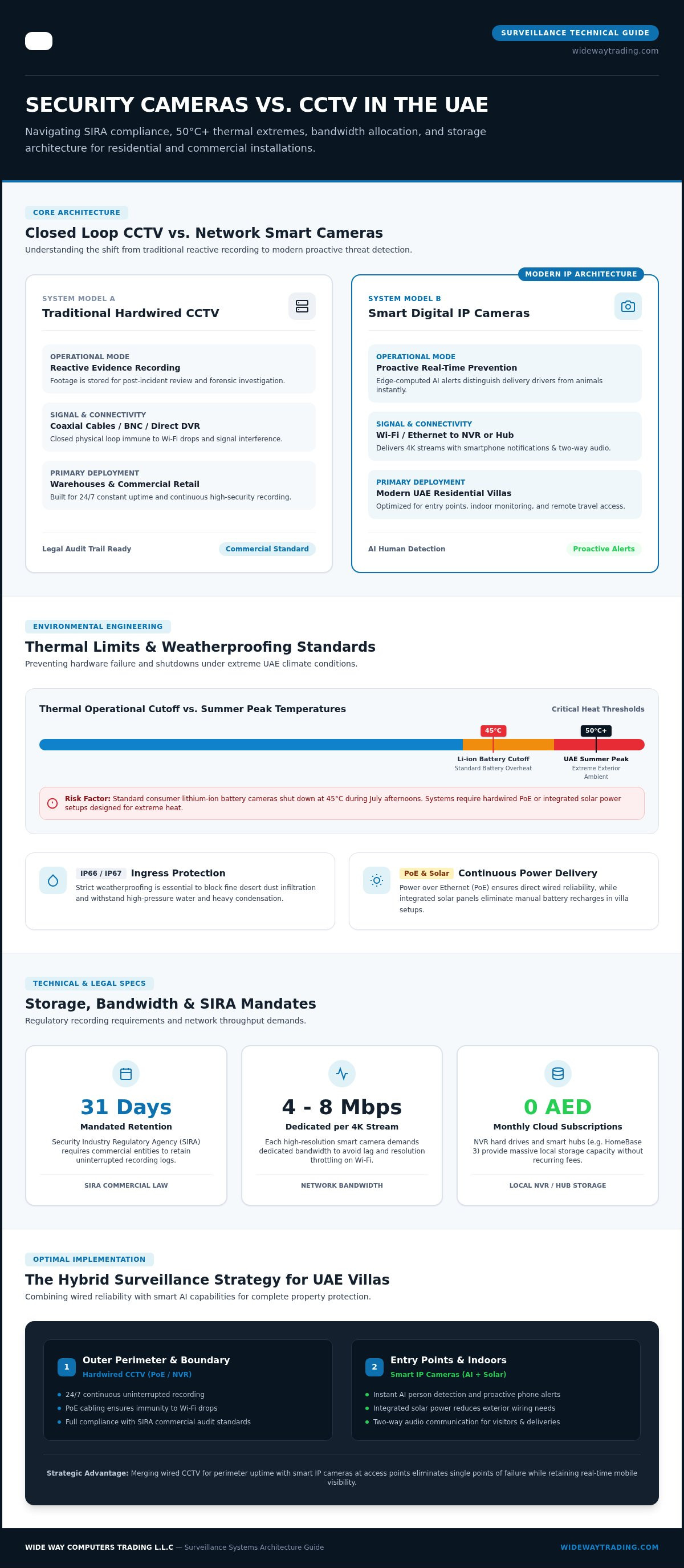
Traditional closed-circuit television systems rely on a hardwired architecture. These setups use coaxial cables and BNC connectors to link cameras directly to a central Digital Video Recorder (DVR). The signal stays within the local loop. This provides unmatched stability for 24/7 recording. It doesn't rely on your Wi-Fi signal or internet bandwidth. For large commercial properties or high-security zones, this physical connection remains the gold standard for signal integrity. The hardware is simple but robust. It's built for continuous operation without the risk of signal interference.
The Rise of Smart Security Cameras
Digital IP (Internet Protocol) cameras represent the modern standard for smart home integration. These devices transmit data over Wi-Fi or Ethernet cables to a Network Video Recorder (NVR) or a local hub. They offer features that traditional analog systems can't match. You get real-time mobile app alerts, two-way audio communication, and advanced AI human detection. Brands like Eufy and EZVIZ have pioneered this space. They provide high-resolution 4K streams that are easily accessible from your smartphone anywhere in the world. Setup is often faster, and the hardware is designed to look sleek on modern UAE villas.
The most significant shift in 2026 is the move from reactive recording to proactive AI-driven alerts. Old CCTV systems required someone to watch a monitor or review footage after a theft occurred. Modern smart cameras use edge computing to identify specific threats. They can distinguish between a delivery driver and a stray animal instantly. This reduces false alarms significantly. In the UAE, many properties now adopt a hybrid approach. They use wired CCTV for 24/7 perimeter coverage and smart IP cameras for entry points and indoor monitoring. This combination ensures you meet SIRA compliance while enjoying the convenience of mobile notifications.
CCTV remains the primary choice for warehouses and commercial retail spaces requiring constant uptime. Smart security cameras excel in residential settings where motion-triggered recording and remote access are the priorities. Choosing the right system depends on whether you need a legally mandated audit trail or a convenient way to check on your home while traveling.
Technical Breakdown: Storage, Connectivity, and Power
While the previous section defined the basic architectures, the actual performance of a security camera vs CCTV UAE installation depends on the back-end infrastructure. 4K high-resolution streams are data-heavy. Each camera typically requires between 4 and 8 Mbps of dedicated bandwidth to maintain clarity. If your villa's Wi-Fi network isn't optimized, smart cameras will experience lag or lower resolution. Traditional CCTV avoids this by using dedicated cabling, which ensures a constant, high-bitrate feed regardless of household internet usage.
Local Storage vs. Cloud Subscriptions
UAE property owners increasingly prioritize local storage to maintain absolute control over their data. Unlike cloud-based systems that require recurring monthly fees, traditional CCTV uses physical hard drives within an NVR or DVR. Modern smart ecosystems have adapted to this preference. Devices like the eufyCam S3 Pro connect to a HomeBase 3, which allows for massive local storage expansion without a subscription. Keeping data on-site is also a practical way to meet the 31-day recording retention mandated by Security Industry Regulatory Agency (SIRA) requirements for commercial entities.
Power delivery is the next technical hurdle. Professional CCTV often utilizes Power over Ethernet (PoE), sending both power and data through a single cable for unmatched stability. In contrast, wireless smart cameras have evolved to use integrated solar panels. This "set and forget" approach is ideal for the UAE's environment, providing 24/7 protection without the need for manual battery recharging or complex electrical trenching across your landscape.
Installation Complexity
The physical setup varies significantly between systems. Wired CCTV involves structural drilling and professional cable management, making it a permanent security asset. Wireless smart cameras provide a "no-drill" advantage, which is perfect for tenants or owners of modern villas where preserving the aesthetic is a priority. However, wireless doesn't mean simple; professional calibration is still required to prevent signal dead zones. For a system that balances these technical demands, WIDE WAY COMPUTERS TRADING L.L.C provides specialized expertise to ensure your network can handle the load.
Cybersecurity must be the final consideration for any digital system in 2026. Because IP cameras are connected to the network, they require multi-layer encryption to prevent unauthorized access. Whether you choose a hardwired loop or a Wi-Fi-based kit, ensure your hardware supports the latest security protocols. If you need assistance configuring a secure network, you can explore professional installation services to protect both your property and your digital privacy.
Environmental Resilience: UAE Heat, Dust, and Solar Power
The UAE climate is unforgiving to electronics. When evaluating a security camera vs CCTV UAE setup, environmental resilience is often the deciding factor. In peak summer, ambient temperatures hit 50°C, but direct solar exposure can drive camera surface temperatures as high as 70°C. This is where standard hardware fails. Most consumer lithium-ion batteries feature a safety cutoff that halts charging once the temperature reaches 45°C. Without proper thermal management, your wireless system could go offline exactly when you need it most.
Solar-Powered Security: The UAE Advantage
Solar energy isn't just an eco-friendly choice in the UAE. It's a logistical necessity. With abundant sunlight year-round, kits like the eufyCam S3 Pro 4-Cam Kit Solar provide a "set and forget" solution for large villas. These systems harness enough energy in a few hours to power the device through the night. Decoupled solar panels are particularly effective. They allow the panel to sit in direct sun while the camera remains in the shade, bypassing the 45°C charging threshold. This approach is often more cost-effective than trenching and laying hundreds of meters of electrical wiring across a landscaped perimeter.
Cooling and Thermal Throttling
Durability starts with the right ingress protection (IP) rating. For the desert, look for IP67-rated hardware. This ensures the device is completely dust-tight and can withstand high-pressure sand infiltration during shamals. Brands like EZVIZ and Eufy design their outdoor units with white, UV-reflective casings to minimize heat absorption. It's a simple but vital detail for longevity. If you use a wired CCTV system, ensure the NVR or DVR is housed in a climate-controlled server rack or an air-conditioned room. Hard drives are sensitive to heat, and a cooling failure can lead to data loss.
Maintenance is the final piece of the puzzle. Fine desert dust settles on lenses, blurring footage and triggering false motion alerts. A quick wipe with a microfiber cloth every month keeps the AI sensors accurate. While cameras are high-tech, they must still operate within the UAE Personal Data Protection Law. This means even as you optimize for heat and dust, you must ensure your lenses aren't capturing private areas of neighboring compounds. A resilient system is one that is both physically durable and legally compliant.
Regulatory Compliance: SIRA Standards and Privacy Laws
Compliance in the UAE is non-negotiable. Whether you are evaluating a security camera vs CCTV UAE setup for a retail shop or a private villa, the law dictates your hardware choice. Regulatory bodies like the Security Industry Regulatory Agency (SIRA) set strict benchmarks for commercial entities. These aren't suggestions. They are legal requirements for obtaining or renewing trade licenses. Failing to meet these standards can lead to significant fines, ranging from AED 50,000 to AED 200,000 depending on the violation.
Commercial Property Requirements
Commercial and public-facing facilities must install approved Video Surveillance Systems (VSS). These systems must be deployed by certified contractors. As of 2026, the technical floor is high. Cameras must provide a minimum resolution of 1080p (2 Megapixels). They must also maintain a frame rate of at least 10 to 15 frames per second on every channel. One of the most critical rules involves data retention. Commercial properties must maintain continuous digital recordings for a minimum of 31 days. High-risk facilities, such as banks or precious metal dealers, often face even longer retention mandates. These systems are frequently integrated into centralized monitoring portals for automated health diagnostics and emergency awareness.
Residential Security and the Law
Private villa owners have more flexibility, but they aren't exempt from the law. You don't need a formal permit or inspection to install smart security cameras inside your home. However, your right to protect your property ends at your neighbor's boundary. Capturing footage of neighboring compounds, courtyards, or swimming pools is strictly forbidden. Federal Decree-Law No. 34 of 2021 is very clear on this. Infringing on personal privacy using surveillance devices carries fines between AED 150,000 and AED 500,000. It can even lead to imprisonment.
Two-way audio is another legal gray area. While many smart cameras include microphones, recording audio in public or commercial spaces without written authorization is illegal. It's best to disable audio features for any camera pointing toward a street or shared entrance. Additionally, the UAE Personal Data Protection Law requires prominently displayed bilingual signage. You must inform visitors that 24-hour recording is active. This transparency is essential for the legal use of any surveillance data.
Navigating these regulations requires technical and legal expertise. If you want a system that is fully compliant with national mandates, book a professional installation today to ensure your property meets every legal benchmark.
Designing Your Security Strategy: Professional Installation
A truly effective security strategy is more than a collection of hardware. It is a calculated response to your property’s unique architecture and daily usage patterns. When finalizing the security camera vs CCTV UAE decision, we often recommend a hybrid ecosystem. This approach places high-stability, hardwired CCTV in high-risk zones like external perimeters and warehouses, while utilizing smart cameras for interior entry points and mobile notification convenience. This ensures you have both the legally required continuous recording and the proactive AI alerts needed for immediate response.
Designing this strategy requires a meticulous evaluation of blind spots and lighting conditions. A 4K lens is only effective if it has a clear line of sight and sufficient illumination to identify faces. We analyze entry points to ensure that cameras are placed at the correct height to bypass glare from the low afternoon sun, a common issue in the UAE. Furthermore, we evaluate how your security system interacts with other smart home features, such as perimeter lighting and automated gates, to create a unified deterrent against unauthorized access.
Choosing the Right Hardware
We act as a curator for the UAE market, selecting only the brands that offer the best balance of innovation and durability. For residential flexibility, we provide Eufy and EZVIZ systems that excel in local storage and user-friendly mobile integration. For commercial sectors requiring strict SIRA compliance, we deploy professional-grade CCTV hardware designed for constant uptime. WIDE WAY COMPUTERS TRADING L.L.C ensures that every piece of equipment, from the eufyCam S3 Pro to specialized Imou units, is verified for high-temperature tolerance and signal reliability before it ever reaches your property.
The WIDE WAY COMPUTERS TRADING L.L.C Installation Process
Our installation process is methodical and structured to minimize friction for the property owner. It begins with a comprehensive site survey where we map out camera angles and verify Wi-Fi signal strength for wireless components. We then handle the technical configuration, including local storage expansion and NVR synchronization. Beyond basic security, we specialize in integrating your surveillance feeds with high-end audiovisual setups. This allows you to monitor your property directly on your BenQ or Sony projector screens or through a dedicated QMJM floor-rising screen in your home cinema.
Once the physical installation is complete, our team provides full training on the mobile applications and local management software. We ensure you understand how to retrieve footage and manage AI alert sensitivities to avoid false alarms. To ensure your system is calibrated for maximum longevity and legal compliance, you can secure your property with WIDE WAY COMPUTERS TRADING L.L.C’s professional installation services. This professional handover guarantees that your investment is protected by expert configuration and a valid manufacturer warranty.
Secure Your UAE Property with Confidence
Selecting the right surveillance architecture is about more than just hardware; it's about building a defense that respects both your privacy and the local environment. We've examined the technical and legal nuances of the security camera vs CCTV UAE debate. The ideal system is one that remains operational through the harshest seasons while providing the specific storage and alert features your lifestyle or business requires.
WIDE WAY COMPUTERS TRADING L.L.C acts as your local guide through this evolving technological landscape. As an authorized dealer for Eufy, EZVIZ, and Imou, we specialize in high-end solar-powered kits and professional-grade wired installations. Our expert national installation team ensures that every component is optimized for longevity and seamless performance across your entire property. We don't just sell hardware; we provide the peace of mind that comes from a perfectly calibrated security ecosystem.
Don't leave your property's safety to chance or poor configuration. Get a Professional Security Consultation from WIDE WAY COMPUTERS TRADING L.L.C Today to ensure your property is protected by the best in the industry. Your safety deserves a system that works without compromise.
Frequently Asked Questions
Do I need a permit to install security cameras in my UAE home?
You don't need a specific government permit to install cameras inside your private residence or within your villa's boundary. However, you must comply with federal privacy laws. It's strictly illegal to capture footage of neighboring properties, swimming pools, or private courtyards. Breaching these boundaries can lead to heavy fines under national privacy regulations. Always ensure your lenses are angled to cover only your own property.
Can smart security cameras survive the UAE summer heat?
Premium cameras can survive these conditions if they feature an IP67 rating and robust thermal management. The main challenge is the 45°C safety cutoff for battery charging during peak daylight. Using white-cased designs and decoupled solar panels allows the camera to stay shaded while the panel collects energy. This setup prevents thermal throttling and ensures your system remains operational even when ambient temperatures exceed 50°C.
What is the difference between an NVR and a DVR system?
A DVR (Digital Video Recorder) is the brain of a traditional analog system using coaxial cables. It's a reliable, closed-loop setup. An NVR (Network Video Recorder) works with IP cameras over a network, usually via Ethernet or Wi-Fi. NVR systems are the modern standard because they support much higher resolutions, such as 4K Ultra HD. They also offer more flexibility for remote access and AI-driven analytics.
Is solar power reliable for security cameras in the UAE?
Solar power is exceptionally reliable across the country due to the consistent, year-round sunlight. Modern kits like the eufyCam S3 Pro use high-efficiency integrated panels to maintain a full charge with just a few hours of exposure. This eliminates the need for complex electrical wiring across your perimeter. It's a "set and forget" power solution that provides 365-day battery life without any manual intervention.
Do I have to pay a monthly subscription for Eufy or EZVIZ cameras?
You don't have to pay recurring fees if you choose hardware that supports local storage. This is a significant factor in the security camera vs CCTV UAE decision. Brands like Eufy and EZVIZ allow you to store encrypted footage on a local hub or microSD card. You own your data and can access it via your smartphone for free. This avoids the long-term costs associated with cloud-only surveillance brands.
How long do security cameras store footage by law in the UAE?
Commercial properties are legally required to store digital video recordings for a minimum of 31 continuous days. High-risk facilities like banks or jewelry stores may need to retain footage for 90 days or longer. For residential villas, there's no mandatory storage duration. Most homeowners choose to keep 14 to 30 days of footage on their local hard drives or hubs to ensure they can review past events.
What is SIRA approval and does my small business need it?
SIRA is a regulatory agency that sets technical benchmarks for security systems. Most commercial entities, including small businesses in retail or warehousing, need a system that meets these standards to secure their trade licenses. This includes specific requirements for camera resolution and data retention. Having a system that follows these mandatory technical standards ensures your business is legally compliant and fully protected against operational risks.
Can I monitor my UAE security cameras while traveling abroad?
You can monitor your property from anywhere in the world as long as your cameras are connected to the internet. Modern IP and smart cameras use encrypted mobile apps to provide real-time streams and push notifications. You can check your 4K feed, use two-way audio, or review recorded clips while traveling abroad. This remote accessibility is a standard feature for almost all digital security systems currently available.


