

The cheapest quote on your desk often turns out to be the most expensive purchase you will make. Comparing security proposals quickly exposes a chaotic market. One contractor quotes a minimal sum for standard hardware, while another demands three times as much for what looks like the exact same gear. It's frustrating to wade through wildly inconsistent numbers, especially when you're trying to dodge mandatory monthly subscriptions or surprise re-cabling fees. Evaluating a realistic security system installation price shouldn't feel like solving a puzzle.
True installation value reflects physical durability and storage independence, not arbitrary package markups. You shouldn't have to guess whether your property's existing infrastructure will hold up or whether budget equipment will fail during critical moments. This guide uncovers the genuine cost drivers behind hardware quality, structured cabling, and skilled labor. You'll gain a clear evaluation framework to compare installer quotes objectively, choose the right architecture for your layout, and secure your property without signing away control to recurring fees.
Key Takeaways
- A transparent security system installation price reflects structural labor, network provisioning, and hardware durability rather than arbitrary package tiers.
- Wire-free and solar-powered setups dramatically reduce labor time and wall penetrations, while hardwired CCTV networks provide permanent, high-bandwidth infrastructure.
- Prioritizing high-capacity local storage over mandatory monthly cloud subscriptions shields your long-term budget from compounding ownership fees.
- Accurate quote evaluation requires itemized breakdowns of specific hardware models and cabling grades to prevent installers from cutting corners with inferior materials.
- Professional camera mapping ensures proper angle coverage and sensor positioning, eliminating critical blind spots and costly false alarms.
What Drives the Price of Security System Installation?
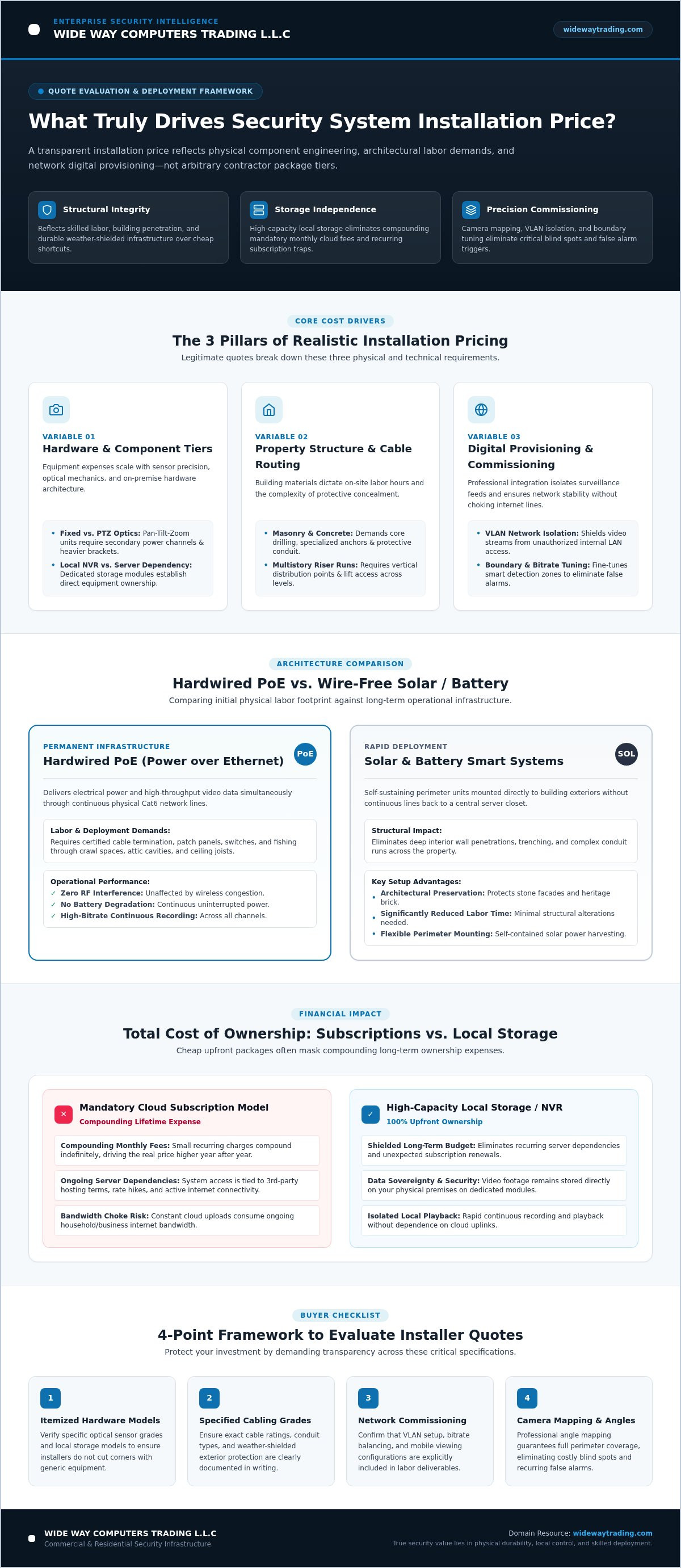
A realistic security system installation price reflects three interdependent variables: component engineering, physical architecture, and digital provisioning. Many commercial quotes obscure these differences beneath generic package names. That practice leaves property owners unable to tell whether they're paying for premium industrial sensors or simply subsidizing inflated contractor margins. A true turnkey installation delivers reliable performance because professional technicians design around real structural barriers, rather than leaving you to troubleshoot erratic DIY hardware.
Hardware Selection and Component Tiers
Baseline equipment expenses depend heavily on sensor grade and optical mechanics. Fixed-lens cameras cover narrow target spots efficiently, but expansive properties demand specialized optics. Pan-tilt-zoom units require secondary power channels and heavier mounting brackets, which increases field labor. Beyond the lenses, storage infrastructure dictates the equipment bill. Opting for centralized network video recorders or dedicated high-capacity local storage modules removes ongoing server dependencies, establishing clear equipment ownership right away.
Property Architecture and Cable Routing
Physical structure dictates how many hours technicians spend on site. Modern security alarm systems and surveillance setups face radically different installation hurdles depending on building materials:
- Masonry and solid concrete: Demands core drilling, specialized anchors, and surface-mounted protective conduit to shield data lines.
- Finished drywall: Requires precise in-wall fishing techniques to hide cabling without causing structural damage.
- Multistory layouts: Adds vertical riser runs, external lift requirements, and network distribution points between floors.
Concealing exterior cable runs takes extra time, but it protects sensitive wiring from weather exposure and intentional tampering.
Network Configuration and System Commissioning
Physical mounting is only half the job. Complete commissioning ensures every camera communicates securely without choking your primary internet bandwidth. Technicians segment your surveillance hardware onto isolated virtual local area networks, shielding video streams from unauthorized internal access. They balance bitrates, fine-tune smart detection boundaries, and eliminate false alarm triggers across your perimeter. Calibrating viewing apps across phones and local control consoles finalizes the deployment. This thorough commissioning justifies the security system installation price by providing an immediate, fully optimized defense perimeter on day one.
Wired CCTV vs. Wire-Free Systems: Comparing Setup Expenses
Choosing between hardwired architecture and wire-free equipment represents the single largest fork in your security system installation price. Property owners frequently assume wireless gear is universally superior simply because it avoids structural disruption. The reality comes down to trade-offs between upfront labor duration and permanent physical infrastructure. While a hardwired setup demands intensive on-site routing, wire-free configurations cut physical deployment hours dramatically.
Hardwired Power over Ethernet Installation Demands
Power over Ethernet (PoE) systems rely on continuous physical lines that deliver electrical current and high-throughput video data simultaneously. This setup requires certified termination, structured patch panels, and commercial network switches. Labor accounts for the bulk of this investment. Technicians must physically fish cables through crawl spaces, attic cavities, and ceiling joists. The return on that effort is absolute stability: zero radio frequency interference, no battery degradation, and uninterrupted high-bitrate recording across every camera channel.
Solar and Battery Smart Camera Deployment
Modern battery-operated units paired with compact solar panels present a compelling alternative. Instead of running continuous Cat6 lines back to a central server closet, installers mount self-sustaining hardware directly to building perimeters. The benefits include:
- Minimal structural alteration: Eliminates deep wall penetration, interior trenching, and complex conduit runs.
- Architectural preservation: Protects stone facades, heritage brick, and finished exterior surfaces from visible piping.
- Rapid deployment: Drops physical mounting and alignment times down to a fraction of a full wired build.
- Self-sustaining power: Uses integrated solar panels to harvest daylight, ending manual battery recharging routines entirely.
Recent industry evaluations, including a Consumer Reports survey analyzing consumer security trends, highlight how initial setup methods shape overall satisfaction and ongoing maintenance expenses. For many properties, a hybrid deployment delivers the optimal balance. You cananchor high-traffic entryways and core perimeter points with hardwired CCTV, then extend coverage to remote gates and detached outbuildings using wireless solar kits. If you want to configure an architecture tailored to your layout, consulting a specialist for professional security camera installation ensures both transmission stability and optimal equipment positioning without overinflating your setup budget.
Total Cost of Ownership: Subscription Traps vs. Local Storage
A suspiciously low security system installation price often serves as financial bait. Many mass-market providers heavily discount upfront labor and hardware because their business model relies on mandatory cloud storage contracts. Over a three- to five-year equipment lifecycle, these recurring monthly fees accumulate quietly, routinely overtaking the initial invoice. Calculating true ownership demands looking beyond day one and examining where your video data actually lives.
The Compounding Math of Cloud Storage Plans
Cloud surveillance vendors typically structure their pricing on a per-camera, tiered basis. As you expand coverage across extra entry points, driveways, and side passages, recurring software expenses multiply rapidly. Beyond the financial drain, cloud models introduce operational bottlenecks. External servers frequently throttle pristine 4K video feeds to save provider bandwidth, compressing crisp optical data into grainy clips. Worse still, your footage remains hostage to an active billing cycle. Cancel the service or experience a network outage, and your access to historical incident archives vanishes instantly.
The Economic Advantage of On-Premises Storage
On-premises storage shifts control back to the property owner. Storing feeds on local network video recorders or encrypted smart hubs requires an initial hardware purchase, but it permanently eliminates monthly recurring fees. Key advantages include:
- Definite ownership: A single hardware investment secures your archive for the physical life of the drive, free from licensing renewals.
- Uncompressed video fidelity: High-resolution streams write straight to local storage at full bitrate without cloud downscaling or frame drops.
- Bandwidth preservation: Continuous local recording runs across your internal network without consuming external internet upload speeds.
- Offline resilience: Surveillance continues uninterrupted even if local internet service experiences an extended blackout.
Factoring recurring storage liabilities into your initial calculations reframes the entire purchasing decision. A transparent security system installation price that includes high-capacity local storage hardware may appear higher initially, but it protects your budget against endless recurring fees while guaranteeing permanent ownership of your private video records.
How to Evaluate Professional Installation Quotes Accurately
A transparent contractor quote itemizes individual deliverables instead of hiding behind single lump-sum packages. When you examine a proposal, you need to understand what you're buying: the specific camera models, exact cabling standards, and defined labor hours. Unusually cheap estimates often mask structural compromises. Cutting corners on core supplies drops the immediate security system installation price, but it leaves you with failing lines and premature hardware replacements.
Auditing Materials and Hardware Inclusions
Always verify the physical building blocks listed on the bid. Low-cost contractors frequently swap out specified networking supplies for cheap alternatives that undermine system stability. Inspect quotes for these critical standards:
- Pure copper Cat6 cabling: Demand solid bare copper lines. Substandard copper-clad aluminum (CCA) degrades quickly over distance and creates severe resistance issues under continuous Power over Ethernet loads.
- Weatherproof terminal enclosures: Outdoor connections require exterior junction boxes carrying verified IP66 or IP67 ratings to stop moisture intrusion and corrosion.
- Authorized equipment distribution: Ensure your hardware comes from proven manufacturers, such as Eufy or EZVIZ, that actively maintain secure firmware and dependable mobile applications.
Validating Scope of Work and Technician Deliverables
Technician labor should involve far more than drilling holes and clipping plastic mounts. Professional deployment demands detailed commissioning to ensure real protection. Your written statement of work must explicitly include daytime and nighttime optical adjustments to prove lenses don't catch blinding reflections from soffit lights or streetlamps. Technicians must also run end-to-end signal tests on all terminated channels and calibrate custom smart detection zones to prevent nuisance alerts.
Workmanship coverage matters. A reputable provider backs their physical routing, structural penetrations, and hardware mounts with a clear labor warranty alongside manufacturer guarantees. To secure fully transparent, itemized quotes built around genuine hardware performance, review your property's surveillance needs and get an expert installation security system assessment before signing any contract.
Maximizing Value with a Tailored Professional Setup
Off-the-shelf security bundles rarely match the physical contours of an actual property. Pre-packaged kits inevitably force compromises: cameras get pointed in arbitrary directions, key access pathways stay unmonitored, and homeowners end up with redundant equipment they never use. A tailored layout aligns physical hardware directly with structural choke points, entryways, and access drives. This purposeful engineering maximizes your return on investment, ensuring every dollar in your security system installation price contributes directly to reliable coverage rather than idle hardware.
Strategic Placement and Perimeter Architecture
Positioning security cameras demands strict spatial precision. A poorly mounted lens delivers useless, backlit footage or sits low enough for intruders to tamper with by hand. Experienced technicians calculate mounting heights and sightlines to ensure crisp facial identification while protecting the physical housing. They overlap viewing angles systematically across perimeter runs, making sure no camera has a blind corridor beneath its mounting bracket.
Property layouts with detached structures present unique challenges. Running physical data lines across paved driveways to an isolated garage or gate can involve costly ground trenching. In these situations, integrating wireless smart hardware bridges the gap cleanly:
- Targeted optical coverage: Wide focal lengths guard broad yard expanses, while narrow lenses focus tightly on front doors and gates.
- Architectural preservation: Battery units with integrated solar panels mount directly to external structures without cutting through exterior masonry.
- Unified perimeter: Solar-assisted units and hardwired networks communicate across a coordinated monitoring hub, operating as a single ecosystem.
Seamless Hardware Integration and Professional Support
Even premium cameras deliver poor defense if notification pipelines lag. Commissioning requires synchronizing smart detection alerts so you receive immediate mobile notifications the moment an individual enters a restricted boundary. Technicians establish secure routing to allow seamless remote live viewing and swift retrieval of stored incident clips from high-capacity local drives.
Working with specialized hardware curators guarantees ongoing performance. Instead of leaving you to troubleshoot erratic Wi-Fi drops or mismatched components, professional installers source proven ecosystems and stand behind the operational integrity of your build. To map a surveillance plan tailored precisely to your property's dimensions and architecture, contact Wide Way Computers Trading for expert security camera installation.
Take Full Control of Your Property Security
Evaluating an honest security system installation price comes down to long-term ownership and architectural integrity. You don't have to choose between fragile DIY gear and restrictive cloud contracts. By combining robust local storage with a tailored camera layout, you maintain total privacy while shielding your budget from compounding monthly fees. Pure copper cabling, deliberate sensor positioning, and optimized optical angles deliver reliable protection that stands the test of time.
Investing in the right architecture from day one prevents costly retrofits later. As an authorized provider of smart ecosystems like Eufy and EZVIZ, Wide Way Computers Trading delivers turnkey installation across the country. Our specialists manage everything from site assessment and physical mounting to structured cabling and app configuration. That means you get complete administrative ownership of your security data without mandatory subscriptions. Protect your property with precision hardware and expert setup. Request a professional security installation consultation today.
Frequently Asked Questions
How much does professional security system installation generally depend on property size?
Property square footage directly impacts the required camera count, cable lengths, and network distribution points. Larger estates demand longer wire runs, signal repeaters, and multi-switch architecture to maintain signal clarity across distant zones. In contrast, compact structures require fewer vantage points and simpler conduit routing. Consequently, overall security system installation price scales with property footprint primarily because larger perimeters require significantly more physical labor and structured cabling materials.
Is professional security camera installation worth the extra investment over DIY setup?
Yes, professional installation delivers structural durability, optimal field-of-view alignment, and network stability that basic DIY efforts rarely achieve. Certified technicians identify critical blind spots, conceal vulnerable wiring inside protective conduits, and isolate camera traffic on dedicated subnets. This precise setup prevents missed events, stops unauthorized network intrusion, and saves you from troubleshooting hardware disconnections or weather damage down the road.
Do all security systems require ongoing monthly subscription fees after installation?
No, systems designed around local storage operate completely free of recurring monthly fees. Deployments utilizing dedicated hard drives or encrypted smart hubs keep all high-definition footage stored securely on your property. You retain complete administrative control and instant access to your incident archives through companion mobile apps without paying compulsory subscription costs, significantly lowering your five-year total cost of ownership.
Can wire-free solar security cameras match the reliability of hardwired CCTV systems?
Wire-free solar cameras match hardwired systems for general perimeter awareness and motion-triggered event recording. Modern integrated solar panels harvest sufficient ambient daylight to keep internal batteries charged continuously, eliminating manual recharging cycles. However, properties requiring uninterrupted continuous stream recording still benefit most from hardwired Power over Ethernet infrastructure, which provides constant electrical current and uncompressed data throughput regardless of sunlight or wireless conditions.
What hidden expenses often appear on low-cost security installation estimates?
Budget quotes frequently omit essential structural materials, such as weatherproof exterior junction boxes, solid core copper cabling, and surge suppression hardware. Installers offering an unusually low security system installation price often compensate by charging extra on site for wall penetrations, high-ladder access, firmware provisioning, or platform user licensing. Always demand an itemized scope of work covering all physical consumables and digital commissioning before work begins.
How long does a standard residential or commercial security camera installation take?
Most standard residential or small commercial installations wrap up within one to two business days. Wire-free or solar smart setups can take just a single afternoon because they avoid extensive structural routing. Conversely, complex multi-camera installations involving solid concrete drilling, underground exterior conduit, and structured network rack configuration require two or more days to complete thorough testing and digital commissioning.


