

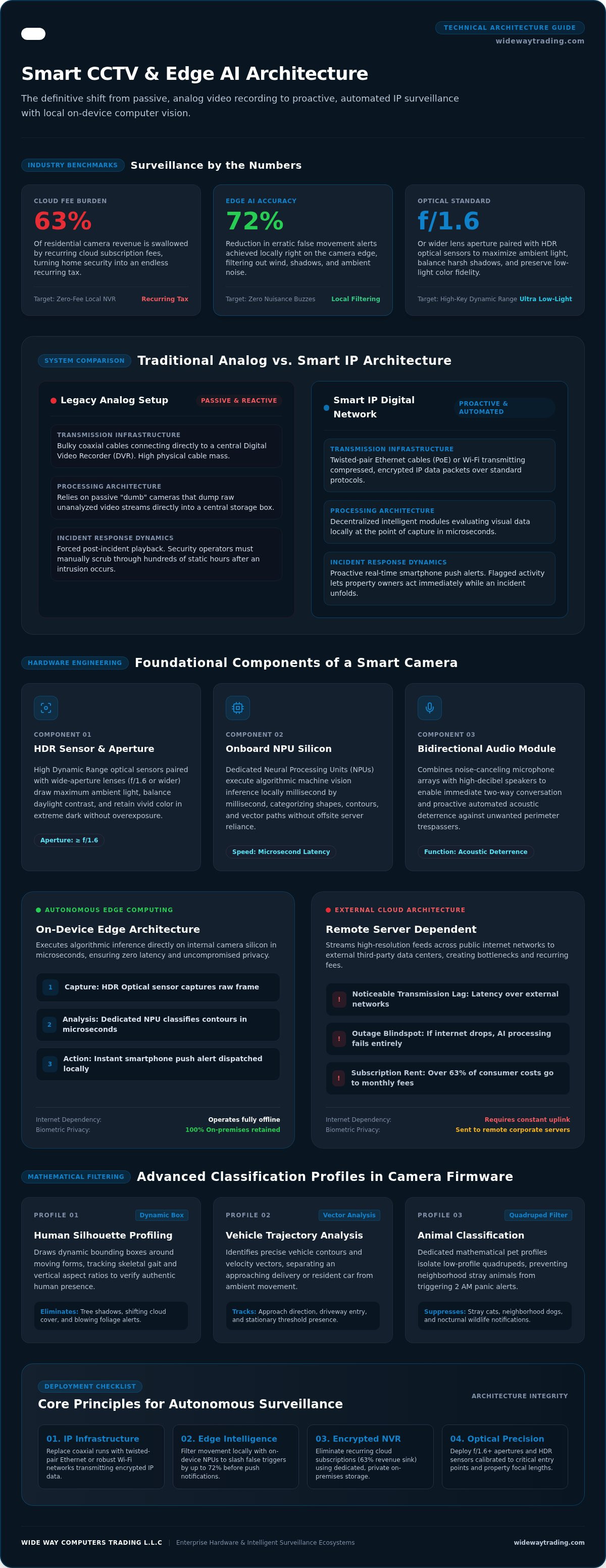
Recurring cloud fees now account for over 63% of residential camera revenue, turning basic security into an endless monthly tax. You shouldn't have to rent your own peace of mind. Nor should your phone buzz twenty times an hour just because wind stirred the bushes or a shadow shifted across the driveway. Investing in smart CCTV shouldn't lock you into recurring contracts or overwhelm you with erratic false alarms.
Security hardware has evolved. Dedicated on-device artificial intelligence can now reduce false alerts by up to 72% right at the edge, accurately distinguishing people and vehicles without off-site cloud processing. This architectural guide gives you the tools to master smart CCTV, eliminate monthly storage fees, and secure your property on your own terms. We break down the technical differences between legacy analog and intelligent IP systems, weigh wireless convenience against hardwired stability, and outline a clear roadmap for equipment selection and professional deployment.
Key Takeaways
- Understand the architectural shift from passive analog recording to proactive, automated smart CCTV systems.
- Discover how on-device edge processing eliminates false movement alerts by filtering human silhouettes and vehicles locally.
- Protect your video privacy and eliminate recurring monthly fees by deploying encrypted on-premises storage.
- Learn practical survey techniques to map camera focal lengths and resolutions to your property's specific entry points.
- Explore how curated hardware ecosystems and professional installation secure stable bandwidth and long-term network reliability.
What Is Smart CCTV and How Does It Redefine Surveillance?
Traditional surveillance captures footage passively. It stores hundreds of hours of static video on a disk, waiting for someone to manually scrub through files after an intrusion occurs. A modern smart CCTV system functions differently. It turns surveillance into a proactive perimeter defense by uniting internet protocol (IP) networking with automated computer vision.
Instead of relying on human eyes to watch monitors, an intelligent surveillance deployment interprets its environment in real time. High-resolution digital video feeds travel across local networks as encrypted IP data packets. The camera processes what it captures instantly. When a vehicle enters the driveway or a delivery worker approaches the threshold, the system flags the specific activity and pushes an immediate notification to your smartphone. You don't need a dedicated monitoring room. You manage system health, adjust motion thresholds, and inspect live streams right from your pocket.
The Core Differences Between Traditional CCTV and Smart Systems
The gap between analog setups and smart digital networks comes down to architecture and speed:
- Transmission Infrastructure: Traditional setups rely on bulky coaxial cables connecting directly to a central Digital Video Recorder (DVR). Smart IP units run on twisted-pair Ethernet cables or Wi-Fi, transmitting compressed, secure video packets over standard network protocols.
- Processing Location: Legacy systems rely on dumb cameras that dump raw footage into a central box. Smart units operate as decentralized processing modules, evaluating visual data at the point of capture.
- Alert Dynamics: Analog systems force you into manual post-incident review. Smart systems prioritize real-time interactive push notifications, letting you act while an incident is unfolding.
Essential Hardware Elements of an Intelligent Surveillance System
Modern hardware engineering powers these proactive capabilities. Understanding what a smart camera is requires looking beyond basic megapixel counts to three foundational components:
First, high dynamic range (HDR) optical sensors paired with wide-aperture lenses (often f/1.6 or wider) capture maximum light. They balance harsh daylight shadows and maintain color fidelity in extreme low-light environments without blowing out exposure.
Second, onboard Neural Processing Units (NPUs) handle heavy computational vision models. These specialized chips run continuous machine vision algorithms locally, analyzing shapes, contours, and movement vectors millisecond by millisecond.
Finally, integrated bidirectional audio modules round out the physical unit. Combining noise-canceling microphone arrays with high-decibel speakers enables two-way communication and automated acoustic deterrence, allowing you to confront visitors or warn off trespassers instantly.
How Edge AI and Intelligent Detection Eliminate False Alarms
Basic motion detection relies on simple pixel changes. A shifting cloud, a stray cat, or wind-blown branches can trigger a panic notification. Edge-based artificial intelligence fundamentally solves this nuisance. By running neural networks directly on camera processors, modern smart CCTV hardware filters out ambient environmental noise before your phone ever buzzes.
On-Device Edge Computing vs. Cloud Server Analytics
Speed defines modern perimeter security. Sending high-resolution video streams across external servers creates noticeable transmission lag. In contrast, edge computing executes algorithmic inference locally in microseconds. The architectural benefits of edge AI in surveillance include zero latency and uncompromised network privacy. Your camera doesn't need to beam biometric templates to remote corporate servers to recognize a human form. Even if your internet connection drops entirely, on-device silicon continues analyzing threats without missing a frame.
Advanced Recognition Profiles: People, Vehicles, and Animals
Precision relies on mathematical classification models embedded inside the camera's firmware. Deep learning models evaluate incoming visual frames using specialized filters:
- Human Silhouette Profiling: Algorithms draw dynamic bounding boxes around moving forms, tracking skeletal gait and vertical aspect ratios to verify a human presence.
- Vehicle Trajectory Analysis: The processor identifies vehicle contours and velocity vectors, separating an approaching car from background environmental motion.
- Animal Classification: Dedicated pet profiles isolate low-profile quadrupeds, stopping neighborhood animals from waking you at two in the morning.
You can fine-tune these profiles using custom activity zones. Rather than monitoring an entire field of view, you draw virtual boundaries exclusively over high-risk entryways or driveways. The camera completely ignores passing street traffic outside those zones.
Active Deterrence Mechanisms: Light and Sound Integration
Stopping an intrusion before entry requires immediate sensory deterrence. When the neural unit confirms an actual human crossing your designated boundary, it can trigger onboard countermeasures automatically. High-lumen LED arrays switch on to illuminate the subject, stripping away night cover. If the subject lingers, the system initiates an audible warning tone or a multi-decibel siren. You can easily schedule these active deterrence windows around normal household routines so delivery personnel during daytime hours aren't startled.
Sourcing balanced hardware that pairs sharp edge analytics with on-device deterrence requires careful curation. Exploring proven ecosystems through WIDE WAY COMPUTERS TRADING L.L.C helps ensure your deployment relies on reliable processing silicon rather than empty marketing promises.
Smart CCTV Storage: Local NVR Architecture vs. Cloud Subscriptions
Every security camera generates continuous data streams. Where that video lands determines your ongoing costs, your network speed, and your personal privacy. Relying on remote servers turns your setup into an ongoing operational expense, while private on-premises storage preserves your budget and keeps your data under your roof.
The True Financial and Privacy Cost of Cloud Subscriptions
Multi-camera households face substantial financial creep. Paying recurring monthly fees for four, six, or eight individual cameras quickly outpaces the original hardware cost over three to five years. Beyond ongoing fees, off-site hosting exposes private domestic video to external server vulnerabilities and third-party data breaches. Constant high-bitrate video uploads also saturate household Wi-Fi bandwidth, triggering internet service provider data throttling during peak streaming hours.
Local Network Storage: Home Hubs, NVRs, and High-Endurance Media
Local smart CCTV architectures eliminate cloud dependency entirely. Investing in a physical Network Video Recorder (NVR) or an encrypted central home hub gives you direct control over your surveillance records:
- Centralized Hubs and NVRs: Dedicated recording hubs host physical solid-state drives or multi-terabyte hard disks. They store continuous high-definition footage behind your firewall with zero monthly fees.
- High-Endurance MicroSD Cards: Edge cameras supporting on-device storage require specialized high-endurance cards. Standard consumer cards fail quickly under continuous 24/7 write cycles. Endurance media withstand thousands of overwrite hours.
- Network Attached Storage (NAS): Advanced IP cameras stream footage directly to existing private NAS drives via standardized ONVIF protocols, creating isolated, redundant archives.
Power Supply Configurations: Wired PoE vs. Solar Harvesting
Storage architecture dictates your power delivery needs. High-throughput continuous recording generally demands stable hardwiring, while event-driven systems thrive on independent energy sources:
Power over Ethernet (PoE) remains the gold standard for high-bandwidth NVR deployments. A single Cat6 Ethernet cable carries both 48V DC power and high-speed data transmission up to 100 meters. You get total signal stability with zero wireless congestion.
For locations where pulling network cable isn't practical, integrated photovoltaic solar cells deliver continuous operation. Modern solar units pair high-efficiency solar panels with substantial internal lithium-ion batteries. The solar panel maintains the charge during standard daylight hours, while the internal battery buffer powers detection and recording through consecutive overcast days. Pairing solar power with localized wireless hubs lets you secure perimeter gates, detached garages, and remote fence lines without digging trenches or managing monthly fees.
How to Plan and Deploy an Intelligent Surveillance Network
Careful site planning separates a reliable security grid from an expensive collection of blind spots. Before drilling mounting brackets into masonry, you must audit the physical terrain, optical geometry, and network pipeline. Balancing these variables guarantees uninterrupted coverage across every vulnerable approach.
Evaluating Camera Optics: Resolution, Field of View, and Night Vision
Every surveillance zone requires matching optical specifications to specific viewing goals:
- Focal Length and Field of View: Wide-angle lenses (2.8mm) excel at general spatial awareness across broad courtyards and open patios. Narrow focal lengths (4mm to 6mm) narrow the horizontal view, providing optical reach to resolve faces and license plates at perimeter entry gates.
- Pixel Density: High resolution alone does not ensure identification. An evidential capture requires adequate pixels per foot at target distances. Digital zoom on a poorly placed 1080p sensor produces unrecognizable blur. Resolving facial traits past ten meters demands higher sensor density.
- Low-Light Sensor Technology: While standard infrared arrays illuminate scenes in monochrome, advanced low-light optical sensors utilize ambient light to maintain full-color forensic details throughout the night.
Network Optimization: Wi-Fi Signal Strength and Hardwired Drops
Intelligent streams demand uninterrupted local bandwidth. Thick reinforced concrete and low-emissivity glass degrade wireless transmission speeds rapidly. If signal attenuation drops below practical thresholds, cameras drop offline or stutter during critical detection events. Placing dedicated outdoor mesh nodes near exterior camera clusters restores vital link margins. For critical, high-risk points, pulling shielded Cat6 copper cabling back to a central switch guarantees interference-free data throughput regardless of domestic wireless congestion.
Environmental Protection and Thermal Resilience
Outdoor surveillance hardware faces severe ambient punishment. Ingress protection ratings dictate longevity. Deploying hardware rated at IP65 provides protection against basic water spray, but exterior perimeters exposed to wind-driven dust require IP67-rated enclosures with sealed gasket seals.
Direct thermal radiation creates internal heat buildup that can shut down inferior units. Position cameras under roof overhangs or architectural soffits to minimize sustained sunlight exposure. Routine maintenance matters too. Wiping down lens covers and clearing dust film off integrated photovoltaic panels preserves charging efficiency and sharp visual clarity throughout seasonal shifts.
Navigating structural layout hurdles, data routing, and thermal demands takes practical experience. You can streamline your deployment by scheduling a specialized security camera installation to ensure robust placement and long-term hardware performance across your property.
Selecting and Deploying Your Smart CCTV System
Building a cohesive surveillance grid requires matching specialized hardware to individual property zones rather than scattering identical cameras everywhere. A synchronized smart CCTV ecosystem ensures reliable perimeter tracking, clean interior coverage, and seamless control across a single centralized mobile dashboard.
Curated Hardware Ecosystems for Complete Property Protection
Different vantage points demand distinct physical designs:
- Driveways and Open Grounds: Dual-lens pan-and-tilt units like the Eufy s340 deliver sweeping coverage, combining wide-angle framing with secondary telephoto lenses for automated subject tracking across open yards.
- Exposed Perimeter Boundaries: Long walls and detached outbuildings benefit from independent solar power. Deploying a setup like the eufyCam S3 Pro 4-Cam Kit Solar provides high-resolution coverage without trenching electrical conduit across your yard.
- Interior Spaces: Discrete EZVIZ Smart Home Cameras handle interior entryways and common corridors, providing compact forms and physical privacy shutters when you are home.
DIY Implementation vs. Certified Professional CCTV Installation
Placing an indoor camera on a shelf is simple enough for anyone. Complex exterior deployments present substantial physical hurdles. Drilling into exterior masonry with improper anchors leads to loose brackets and water ingress over time. Poor ladder positioning creates severe fall hazards, while misjudged camera angles can accidentally capture adjacent properties, creating neighbor privacy disputes. Certified technicians ensure rigid mounting, neatly conceal cabling inside protective conduit, and configure your local network switch to prevent video traffic from choking household internet speeds.
System Verification, Commissioning, and Ongoing Operation
Physical mounting is only the halfway mark. Proper commissioning guarantees dependable day-to-day operation. Walk test your property during bright midday light and pitch-black conditions to calibrate detection sensitivity zones, confirming that vehicle movements and pedestrian approaches trigger alerts while ambient movement stays silent.
Configure multi-tier access profiles inside your management app, granting household members live viewing rights while keeping administrator settings locked. When you want clean cable management, secure mounting, and guaranteed network stability across every zone, opting for professional Security Camera Installation ensures your property defense operates with absolute precision from day one.
Secure Your Property with Next-Generation Intelligence
Modern property protection has outgrown passive recording and mandatory monthly fees. Deploying an intelligent smart CCTV architecture puts you back in total control of your perimeter security. On-device edge processing eliminates erratic motion alerts, while private local storage safeguards domestic privacy and eliminates recurring cloud overhead for good.
Reliable surveillance demands matching proven hardware to the specific layout of your home or commercial site. As an official distributor of tier-one security camera ecosystems, WIDE WAY COMPUTERS TRADING L.L.C provides curated, subscription-free solar setups and local storage hubs. Our experienced technical teams deliver comprehensive professional installation and network configuration services nationwide, ensuring your cameras are mounted securely, your data links remain stable, and your angles leave zero blind spots.
Take the uncertainty out of your perimeter defense. Discover Professional Smart CCTV Systems and Installation today to equip your property with dependable, intelligent protection built for the long term.
Frequently Asked Questions
How does a smart CCTV camera differ from a traditional analog security camera?
A smart CCTV camera processes visual data on-device using integrated computer vision and network connectivity, whereas an analog camera merely transmits raw video signals over coaxial cables to a central recorder. Smart cameras provide real-time event filtering, instant mobile alerts, and decentralized video processing. Analog setups lack autonomous intelligence, requiring manual searching through continuous recordings after a security breach occurs.
Do smart CCTV cameras require a paid monthly cloud subscription to work?
No, smart CCTV cameras do not require a paid monthly cloud subscription if you choose hardware built for local storage. Systems with onboard memory cards, home base stations, or Network Video Recorders save encrypted video directly to your premises. You get full access to live streaming, push alerts, and video playback through your mobile app without signing up for recurring monthly contracts or third-party cloud tiers.
Can smart security cameras function during an unexpected internet outage?
Yes, smart security cameras with local storage and on-device edge processing continue recording and detecting events during an internet outage. The internal neural processor continues classifying humans and vehicles on physical silicon. The camera writes video directly to its onboard memory or local network hub. You only lose remote mobile push notifications and off-site live viewing until your broadband connection comes back online.
What makes solar-powered smart CCTV cameras suitable for extreme outdoor weather?
Solar-powered cameras eliminate external wiring while utilizing ruggedized, weatherproof enclosures that resist intense heat, ultraviolet degradation, and blowing sand. High-efficiency photovoltaic panels charge internal lithium buffers that endure elevated ambient operating temperatures. With ingress protection ratings of IP65 to IP67, sealed gaskets keep fine airborne dust away from internal electronics, ensuring continuous autonomous power and imaging without physical battery swaps.
How do AI detection algorithms distinguish between humans, pets, and background movement?
AI detection algorithms use trained convolutional neural networks to evaluate the geometric shape, proportion, and motion vectors of moving objects. The camera analyzes skeletal movement patterns and vertical aspect ratios to verify a human presence. It contrasts these shapes against low-profile animal silhouettes and erratic pixel fluctuations caused by blowing foliage, ignoring ambient environmental distractions before generating an alert.
Is professional CCTV installation recommended over a self-managed DIY setup?
Yes, professional CCTV installation is strongly recommended for exterior perimeters and multi-camera networks. Professional installers evaluate optimal focal heights, eliminate optical blind spots, and run protective conduit that shields wiring from environmental wear. Certified technicians also optimize local network switches to balance video bandwidth, avoiding Wi-Fi congestion and ensuring your camera mounts remain structurally secure against high winds and vibrations.
How many smart CCTV cameras can a standard home Wi-Fi network support?
Most standard home Wi-Fi networks comfortably support three to five wireless cameras before signal congestion affects connection quality. High-bitrate continuous streams consume substantial upload bandwidth and compete with domestic devices. Deploying dedicated network access points, moving to a wired Power over Ethernet architecture, or using cameras linked to a centralized local base station prevents wireless bottlenecks across larger installations.


